
Is Santa Clara Moving in the Right Direction?
Santa Clara once led California in municipal ethics. Its nationally recognized ethics program was studied and copied. Residents trusted it.
Something is wrong. The people feel it.
Santa Clara now faces four defining decisions that will either rebuild public trust through ethical leadership—or deepen a City Hall culture that ignores ethics, rejects criticism, excludes the public, and fails to protect public trust.
The choice is now in the hands of the people.
Look at Santa Clara City government today. Is this the best we can do?
What kind of City do you want Santa Clara to become?
What You Need to Know in Two Minutes
In 2000, Santa Clara was on its way to becoming one of the most ethical cities in California.
In 2010, voters approved a new stadium—14,628 to 10,505—in a city of approximately 116,000.
Since then, confidence in the City’s direction has declined sharply. The share of residents who believe Santa Clara is on the wrong track has grown from 13% to 60%.
At the same time, the ethics program has been dismantled. The Code of Ethics & Values and Behavioral Standards are now at risk of being replaced with “follow the law” compliance codes—the most minimal standard—and one the City rejected 25 years ago.
Major decisions are increasingly made without meaningful attention to ethics or public trust—and without meaningful public input.
It Worked… Until It Didn’t
For more than a decade, Santa Clara’s Ethics & Values Program worked.
It worked because it focused on two practical—and measurable—objectives: building public trust and making Santa Clara a great municipal workplace.
Its ground-breaking Code of Ethics & Values—developed with broad stakeholder input—defined what ethical leadership for public trust looks like in practice and required everyone in City service to integrate the Code into their everyday work.
Strong leadership from the City Council, City Manager, and City Attorney, extensive ongoing training, and an engaged public ensured those standards were understood—and enforced.
It worked. Then it didn’t.
Beginning around 2008—and accelerating after key leadership transitions in 2012—City Council and senior staff priorities shifted. They no longer saw ethics and public trust as central to how the City works.
Since 2015, the program has been quietly dismantled—one piece at a time. By the time most residents noticed, there was little left to save—only public trust to rebuild.
A Defining Moment for Santa Clara
Santa Clara has created a once-in-a-generation public trust inflection point.
At a time when the City is preparing for global events like the World Cup and managing hundreds of millions of dollars in infrastructure projects, it has also launched four major efforts—all at once:
- A comprehensive Charter review
- A rewrite of the Ethics Code
- Consideration of an independent Ethics Commission
- A time-sensitive decision to turn full-year operational control of the Stadium—both NFL and non-NFL seasons, and all City revenues—over to the team for the next 27 years (the Stadium “Put Right”)
Each of these decisions could reshape how the City governs itself. Taken together, they will determine whether Santa Clara strengthens, weakens, or destroys ethical leadership, good governance, and public trust for decades to come. The stakes are that high.
So, Why Now—and Why All at Once?
Why are these decisions being treated as separate, uncoordinated efforts—when together they define Santa Clara’s system of ethics, governance, oversight, accountability, and public trust?
Why limit Charter reform so it doesn’t even discuss, much less regulate, how the ethics code, the independent ethics commission, and the Stadium “put right” fundamentally reshape City governance?
While the Stadium Authority is a separate legal entity—designed to protect the City’s General Fund—it was never intended to be separate from ethics, governance, oversight, accountability, enforcement, or its fiduciary duty to manage the City’s largest public asset on behalf of the people of Santa Clara.
Why has the Stadium become an “ethics-free zone”? And why is the City leaving the Stadium Authority and Levi’s Stadium—the two greatest threats to public trust in Santa Clara—outside the ethics, public trust, and accountability frameworks that apply to the rest of the City?
We don’t know the answers. But we do know the stakes.
If these decisions move forward without coordination, transparency, and meaningful public engagement, Santa Clara risks moving further toward politics without principle and government without ethics. And once public trust is lost at that level, it can take decades to rebuild.
The time for public engagement, independent oversight, and real accountability is now—before these decisions are locked in.
Four Decisions That Will Shape Santa Clara’s Future
Comprehensive Charter Reform?
Will the Charter embed ethics, good governance, and public trust—with real public engagement—and apply them equally to the City and the Stadium Authority?
Or will ethics remain optional, leaving both vulnerable to shifting political control?
Independent Ethics Commission?
Will the City create an independent Ethics Commission with full authority over both the City and the Stadium Authority—with real independence, resources, staffing and best practices for training, advice, enforcement, and oversight?
Or will it establish a weak body—or continue with no meaningful oversight at all?
Universal Ethics Code?
Will Santa Clara restore and strengthen its values-based Code of Ethics & Values—and apply it to both the City and the Stadium Authority?
Or replace it with a minimal compliance code—leaving the Stadium Authority and the City without meaningful standards?
Stadium “Put Right” for the People?
A one-time decision to transfer operational control to the 49ers—for both NFL and non-NFL events—and give the 49ers all revenue from all sources for the next 27 years.
Will the 49er-PAC majority approve what the team wants, or get independent analysis and decide for the people?
Two Questions That Can Change Everything
Every major decision is evaluated for cost, efficiency, and legality. But two questions are almost never asked:
When these questions are ignored, even legal and efficient decisions can fail the most important test: Does the public believe that decision-makers are acting solely in the public’s best interest? That belief is necessary for public trust. Now, with so much at stake, these questions have the power to change the City’s future—if the public engages, insists, and prevails.
How This Government Thinks about Ethics & Trust
When we refer to “the government” in this section, we are referring primarily to the City Council, City Manager, and City Attorney—as individuals and as a group making decisions and setting direction for the City.
The analyses and conclusions you will find throughout this site are based on publicly available information, our own communications with City officials, and reporting from reputable news organizations.
A clear pattern emerges from these sources. It describes what City government looks like today through an ethics lens and with a public trust perspective.
At the highest levels, Santa Clara’s government treats ethics as an unnecessary constraint—or a political weapon—rather than as the standards that prescribe how local government ought to act—at its best—to earn public trust.
See for Yourself
To understand what this Council really thinks about ethical leadership, one another, the public, and the Ethics & Values Program it has been dismantling, we encourage residents to watch—or read the transcript of—the July 11, 2023 Council meeting.
The agenda item was whether to establish an independent ethics commission, as recommended by the Santa Clara County Civil Grand Jury in Unsportsmanlike Conduct (October 2022).
The discussion was the final 50 minutes of a six-hour meeting. Only the Council and senior staff were present in Council Chambers. No media covered it. City staff made no formal recommendation—an unusual occurrence.
As you watch or read, keep in mind that some statements reflect individual opinions or incomplete information. A question to guide your thinking:
Watch the meeting or read the transcript. Draw your own conclusions.
Read what was missing from the agenda report → See the Candidate Guide to Running for Office →What Happens When Ethics Is Ignored
Over the past several years, a clear pattern has emerged in Santa Clara’s most important decisions. These examples show what happens when ethics and public trust are left out of decision-making.
Each of these decisions would likely have been very different if the City had asked—and answered honestly—two questions:
Why, if at all, is this the right thing to do for the people of Santa Clara?
How, if at all, is this likely to build public trust?
For additional details, click the + sign. To close, click the − sign.
49er-funded PACs have spent over $10 million in the last three elections helping elect five of their preferred candidates to a 7-seat Council and Stadium Authority majority. PACs can put unlimited money into campaigns as long as they don’t coordinate with candidates directly.
The 2022 Civil Grand Jury found that these five members “can—and do—vote in a manner favorable to the Team” rather than the public—without ever publicly addressing the conflict the campaign spending creates, or the public perception that the answer from this majority is always “yes.”
Trust requires independence. What we see instead: week after week, Council members—and even senior staff—behave as if they are 49ers employees, supporting everything the Team wants—with no recusals, no City Attorney advisories, no City Manager directives about Stadium Authority ethics.
Read full details →Almost all candidates in Santa Clara agree to spend no more than about $25,000 on their campaigns. It sounds like a level playing field. It isn’t.
Independent expenditures don’t count toward the cap. That’s how 49er PACs can spend millions while their preferred candidates say they didn’t take any special interest money and didn’t exceed the spending limit. Both statements are technically true and completely misleading.
The cap only hurts candidates who run against 49er-backed incumbents. Accept the limit and get outspent twenty to one. Reject it and get attacked for breaking your word.
Trust requires honesty in how elections are conducted. What we see instead misleads voters while calling itself reform.
Self-government means residents—not a single powerful corporation—decide who governs, what information voters receive, and whose interests City Hall serves. For three consecutive elections, 49er-funded PACs have spent over $10 million to secure five of seven Council and Stadium Authority seats.
The 2026 election raises the stakes considerably. Three seats are open—Mayor, and the seats held by Councilmembers Hardy and Chahal—because all three incumbents are termed out. Mayor Gillmor and Councilmember Cox are the only members of this Council who have publicly questioned 49er deals and contracts. The 49ers will almost certainly want that mayor’s seat—and they will want to hold Districts 2 and 3 to keep their 5-2 majority intact.
Here is what their money can do. In 2018, before the PAC spending began, Gillmor beat Becker 74% to 26%—a landslide by any measure. In 2022, the 49ers spent $2.4 million on the same candidate, in the same race, against the same incumbent—aided by endorsements and favorable coverage from the three newspapers that consistently align with 49er interests: the Mercury News, the Silicon Valley Voice, and the Spotlight. They lost by 776 votes. A 48-point margin nearly erased. With a candidate later convicted of felony perjury.
Now there is no incumbent to overcome. The Levi’s Stadium lease runs through 2074. Between now and then there are 25 elections. This is the second one. There is no plan.
Trust requires protecting the integrity of elections before the damage is done, not after. What we see instead is silence—no public discussion, no resident input, no response.
City Attorney Brian Doyle had been asking hard questions about the 49ers when he was fired. City Manager Deanna Santana was fired two days after she raised a conflict of interest before the Council: Al Guido had signed the FIFA World Cup contract simultaneously as the Stadium Authority’s representative and as president of the Bay Area Host Committee—a committee created and funded by the 49ers.
No permanent city attorney for 17 months. No permanent city manager for 14 months. The executives who eventually filled those roles signed nondisclosure agreements giving the team and the Host Committee control over information released to the public—and delivered no ethics directives to staff, no open processes, and a predetermined outcome on the ethics code.
In a Council-Manager city, if the Council says yes to everything, the City Manager and City Attorney are the residents’ last line of defense.
Trust requires executives who can say no. What we see instead is a City Hall that fired the two people who did.
In October 2022, Councilmember Anthony Becker leaked a confidential Civil Grand Jury report—sharply critical of the Council majority’s relationship with the 49ers—to the team’s top lobbyist. That gave the 49ers’ crisis team four days to mount a campaign to discredit the report before it was publicly released.
Becker was indicted in April 2023 on felony perjury and failure to perform his duty. His colleagues made him Vice Mayor and let him vote on every 49ers issue for twenty months, citing “innocent until proven guilty.” That’s a legal standard. Public trust asks a different question: can this Council member act independently? The answer was obvious. No one asked it out loud.
He was convicted in December 2024. The jury deliberated less than three hours. Two colleagues spoke at his sentencing asking for no jail time. He was sentenced to 40 days in a county work program. The 49ers had spent over $3 million supporting his campaigns.
Trust requires that officials protect the public from even the appearance of conflict. What we see instead was a Council that protected its own.
Read full details →During state-required ethics training, the City Attorney’s office told Council members: if you don’t feel like you’re being influenced by personal interests, there’s no need to recuse yourself. This directly contradicts the appearance of impropriety standard cited on the same training slide.
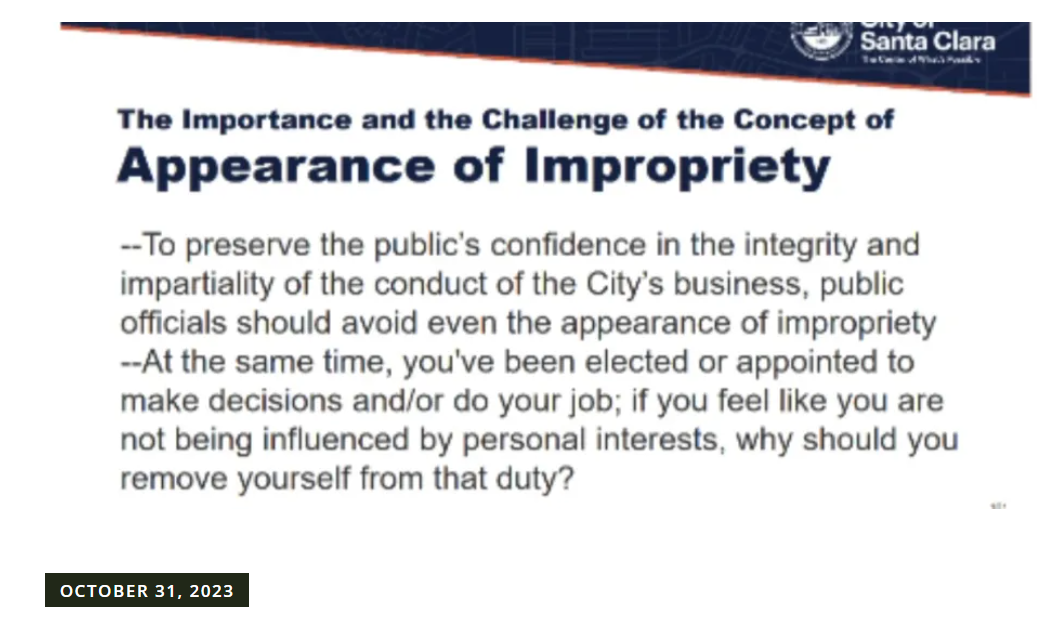
The actual training slide used by the City Attorney’s office.
The appearance standard exists because the public cannot see inside officials’ minds. We can only see their actions. When officials who received millions in PAC support vote repeatedly on 49ers matters without recusal, it looks like a conflict—regardless of how they feel inside. Every ethicist will tell you: conflicted people are the last to know they’re conflicted.
Trust requires teaching the actual standard. What we see instead is training that gives officials permission to vote however they like and call it ethics.
In July 2023, the Council approved hiring an independent ethics consultant through the city’s normal RFQ process. Staff waited eight months before doing anything—then skipped the public process entirely. They sent an informal inquiry to eight law firms. No ethics consultants were contacted. They hired an employer-defense lawyer whose firm had worked with the city for forty years and had her work in secret for a year.
In March 2025 she presented her work not at a public hearing but at a 10 a.m. weekday meeting typically attended by one or two members of the public. What she delivered was not a review but a replacement. The new code covers only the City Council, drops from eight values to six, eliminates all behavioral standards, requires only that members obey the law, and does not apply to the Stadium Authority. The same lawyer is now conducting the ethics commission study.
A public records request for the contract and communications showing how “review” became “replace” was delayed six times over three months, then closed without providing the documents.
Trust requires an open process and an honest product. What we see instead is a closed-door rewrite that abandons 25 years of progress—and the same person deciding what comes next.
Read full details →The Stadium Authority manages Levi’s Stadium—a $1.3 billion public asset generating hundreds of millions in annual revenue. It has never adopted an ethics code. Three Civil Grand Jury reports have recommended ethics reforms for stadium governance. None have been implemented.
The same five Council members who vote as a bloc for 49ers interests on City Council also control the Stadium Authority. The same conflicts. The same closed-door decisions. The same 5-2 votes—just more money at stake.
Trust requires the same ethical standards wherever public assets are involved. What we see instead is a decade of operating a billion-dollar institution with zero ethical guardrails.
The City is conducting its first comprehensive Charter Review in years. The Stadium Authority—which manages a $1.3 billion public asset and has been the subject of three Civil Grand Jury reports—has been excluded from the scope of the review entirely.
Voters are being asked to approve changes to how the City operates while the entity at the center of the City’s biggest governance failures gets a pass. A Charter Review that ignores the Stadium Authority is like a home inspection that skips the foundation.
Trust requires giving voters a complete picture before asking for their approval. What we see instead is a review designed around the problem, not through it.
Over 14 years, successive councils have quietly dismantled Santa Clara’s nationally recognized ethics program—without a single public hearing, without resident input, and without ever officially announcing what they were doing. Resident confidence collapsed from 91% to roughly 40%.
The ethics code, the training program, the core values, the independent ethics consultant, the campaign ethics program—all either eliminated, weakened, or ignored. None required a public vote to cancel. That’s the problem. Charter-level protection means voters—not a Council majority—decide whether ethics infrastructure stays or goes. Without it, the next council can finish what this one started.
Trust requires that residents, not elected officials, decide what kind of City Hall they want. What we see instead is no plan to include any of this in the Charter—and the same approach that produced 14 years of decline.
Read full details →Why Public Trust Now
For four years, residents have complained. Three Civil Grand Jury reports have documented ethics and governance failures. An ethics expert has been raising the alarm publicly since 2022. The City’s own survey shows 60% of residents believe Santa Clara is going in the wrong direction.
Nothing changed. If anything, the complaints and reports have only sped up what we can only describe as an anti-ethics and anti-public-trust agenda.
Someone realized the easiest way to stop ethics complaints is to eliminate the ethics code—so they are replacing Santa Clara’s comprehensive, values-centered Code with a follow-the-law compliance document, drafted behind closed doors by a law firm.
Someone realized the more they rejected an independent ethics commission, the more the Civil Grand Jury would keep recommending one—so now they are studying it, asking questions that cities of every size have already answered, until they can say: we studied it, and it’s just not right for Santa Clara.
That is what this site does. Here is what we promise:
We will be fact-based. Our analyses ask what a reasonable person would conclude with access only to what the public can access. We follow the evidence. We correct errors when we find them.
We will cover what is happening—the ethics code revision, the ethics commission study, the Charter Review—through an ethics lens, so residents are informed about what their government is doing, or failing to do.
We will tell you what the documents mean—not just what they say. Grand Jury reports, contracts, meeting transcripts, public records. Translated into plain language, analyzed for their ethics and public trust implications.
We will create space for genuine democratic dialogue—because the City has been steadily removing opportunities for residents to speak to their government, much less to one another.
We will not tell you what to think—but what to think about, how to think it through, and how to turn thought into practical and effective action for the common good.
We will be honest about what we don’t know—and rigorous about what we do.