
What the 2022 Civil Grand Jury Knew That Most People Missed
Buried in “Unsportsmanlike Conduct” is a small section that changes how we should evaluate every Santa Clara elected official. It’s time to talk about it.
The 2022 Civil Grand Jury report “Unsportsmanlike Conduct” landed with a thud. Its headline findings — that the 49er-backed Council majority “can and do vote in a manner favorable to the SF 49ers,” that the City was putting the team’s interests ahead of the public’s — generated controversy, denials, and a formal rejection from the Council majority.
In all the noise, a small but foundational section was almost entirely overlooked. Tucked into the report’s pages is a concise statement of what public office actually requires — the fiduciary duties every City Council Member and City staff person owes to the people they serve.
This is worth your attention. Because once you understand what fiduciary duties are — and measure Santa Clara’s current council against them — the record speaks for itself.
What Does “Fiduciary” Mean?
The word comes from the Latin fiducia — trust. A fiduciary is someone entrusted to act in another person’s best interest, not their own.
You know the concept from other contexts. A doctor owes a fiduciary duty to a patient. A lawyer owes it to a client. A financial advisor owes it to the person whose money they manage. In each case, the relationship is defined by trust, and betraying that trust — even legally — is a serious breach of professional and ethical obligation.
Public office is the same. When someone is elected or appointed to serve the people of Santa Clara, they become a fiduciary. The people’s interests come first. Always. In public and in private.
The 2022 Grand Jury recognized this explicitly, quoting the Markkula Center’s own statement of the fiduciary duties public officials owe — loyalty, care, impartiality, preserving the public’s trust, and accountability (Unsportsmanlike Conduct, pp. 10–11, citing Hana Callaghan, “Public Officials as Fiduciaries,” Markkula Center for Applied Ethics, 2016). What follows is what each duty means — and why it matters right now.
The Five Fiduciary Duties
1. Loyalty
Loyalty means putting the public interest ahead of personal, private, or special interests in every City matter — without exception.
Not most of the time. Not when it’s convenient. Not when the chamber is full and everyone is watching. At all times, in public and in private.
The Grand Jury found that the 49er-backed majority “can and do” favor the team over the public interest. That is not an accusation of illegal conduct. It is a finding that the duty of loyalty — the most fundamental obligation of public office — is not being met.
A Council Member who received campaign support from a private interest and then votes consistently in that interest’s favor, without disclosing the conflict or recusing, is not meeting the duty of loyalty to the public. The law may permit it. Ethics does not.
2. Care
Care means making decisions with competence, diligence, and full information.
It means doing your homework before you vote. Reading the reports. Seeking independent analysis. Understanding what you’re deciding and why. Not delegating your judgment to whoever has the most access to you between elections.
There is no longer any excuse for arriving at a public meeting unprepared on an ethics question. Any Council Member — any resident — can open a laptop and ask an AI a substantive question and receive a serious, well-reasoned answer in seconds. Try it yourself:
Ask: “How do you build public trust when you are revising your award-winning ethics code?”
Here is how an AI answers that question:
You begin by honoring what made the original code award-winning — the process as much as the product. Award-winning ethics codes are almost always built through broad community engagement: residents, staff, elected officials, and independent ethics experts all contributing to a document that reflects shared values rather than one faction’s preferences.
To build public trust during a revision, you make that process visible and inclusive from the first day — announcing the revision publicly, sharing all existing documents, inviting written input, holding community forums, and publishing draft language for public comment before any decisions are made.
You hire an ethics consultant, not a compliance lawyer. You measure success not by whether the final document is legally defensible, but by whether the community recognizes itself in it. Transparency in the process is itself an act of trust-building — it signals that the code belongs to the people, not to the officials it governs.
Or try this one:
Ask: “What does a City Charter look like when it embeds ethics and public trust into it?”
A charter that genuinely embeds ethics and public trust doesn’t treat ethics as a section to be added at the end — it weaves ethical obligations throughout the document.
It begins with a preamble that defines the City’s purpose in terms of public trust and the fiduciary duties of every official and staff member. It establishes an independent ethics commission with charter-level protection — guaranteed budget, independent staff, staggered appointments insulated from council control, and direct ballot access so the commission can go to voters if the Council blocks needed reforms.
It defines the ethical standards that apply to all city entities, including any stadium or special authority, with no exemptions. It requires transparency by default, limiting closed sessions and NDAs. It protects the City Manager and City Attorney from retaliation for exercising independent professional judgment. And critically — it cannot be weakened without a vote of the people. The charter is the people’s document. Ethics provisions in it belong to residents, not to whoever holds a Council majority at any given moment.
These are not difficult questions. They have clear, well-reasoned answers that any prepared Council Member could find in minutes. The 2022 Grand Jury found that the Council majority arrived at an ethics discussion unable to speak to the history of the program, the Grand Jury’s own findings, or what an independent ethics commission would actually do.
In the age of AI, unpreparedness on a question this important is not an oversight. It is a choice.
The duty of care also falls on the City Manager and City Attorney — the professional staff whose independent judgment is supposed to protect the public even when the Council majority doesn’t want them protected. When those positions are filled by people who have watched three Civil Grand Jury reports go unaddressed and said nothing, who have signed NDAs restricting public information without raising conflict concerns, who have provided legal cover months after the fact rather than guidance before — the duty of care is failing at every level of City Hall simultaneously.
3. Impartiality
Impartiality means representing every resident fairly — and never favoring your supporters, your allies, or the private interests that funded your election over the constituents you were elected to serve.
A Council Member cannot favor those who backed their campaign over those who did not, and must work to overcome whatever bias that support creates. Singling out some constituents for favor — or others for punishment — breaches this duty.
Santa Clara’s Council majority received more than $10 million in 49er PAC support across three election cycles. The 2022 Grand Jury found that these members “can and do” vote in ways favorable to the 49ers. Favoring the private interest that financed your election over the residents who did not is precisely the failure the duty of impartiality exists to prevent. The majority has never collectively recused from a stadium vote, and has never publicly examined how that support might shape its judgment.
4. Preserve the Public’s Trust
Preserving the public’s trust means conducting yourself so residents can rely — in public and in private — on a government that works only for them. It requires avoiding not just impropriety but the appearance of impropriety, because the public cannot see inside an official’s mind; it can judge only what it sees.
When the City Attorney was asked during ethics training what a Council Member should do if they didn’t feel they had a conflict, the answer was: if you don’t feel you have one, it’s okay to vote.
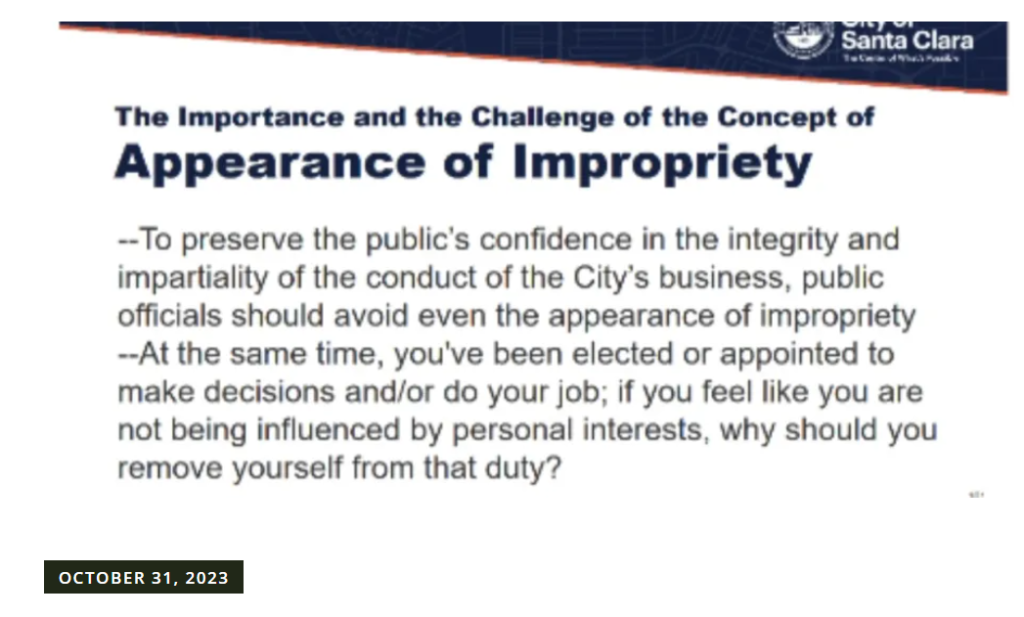
That opinion is contrary to most ethics codes and many laws. The public’s judgment that their government officials practice impeccable ethics — or not — is a perception, a conclusion the public reaches after seeing, hearing, or hearing about Council actions. People base their judgments about Council Members and staff on the actions government takes, and much less on what government says. (“What you are doing is speaking so loudly I can’t hear what you’re saying” is very much at work in determining whether a government is trustworthy or not.)
Most government officials don’t understand that the public can base these judgments only on what they see. The public has no access to how the government officials see themselves or think about their actions; the public knows very little about their past experience. All the public has to go on is what happens in the public meeting.
5. Accountability
Accountability means accepting responsibility for decisions and their consequences — and welcoming the independent oversight structures that make accountability real rather than rhetorical.
From accountability flow transparency, disclosure, open meetings, and the public’s access to records — and that is exactly what Santa Clara’s ethics-code replacement lacked. The City conducted a “review” of its ethics documents that produced a secret replacement: no prior public announcement, no public input, and no documents available even after repeated Public Records Act requests, all while telling the public the process was ongoing after the decisions had already been made. To write an ethics code meant to protect residents and public trust, it turned to a lawyer whose practice is defending city governments against their own employees’ complaints. Accountability is impossible when the work is done in the dark.
the Council majority twice rejected the independent ethics commission the Civil Grand Jury recommended in 2022 before voting unanimously in 2024 to accept the recommendation in Irreconcilable Differences. Promising to establish one by 2025, the Council’s Government and Ethics subcommittee is still studying it and the Charter Review Committee declined to include it in their City Charter recommendations.
In July 2023, the last time the full Council discussed the independent ethics commission, the majority position was that more than enough accountability mechanisms exist. They named the District Attorney, the State’s Fair Political Practices Commission, recall, referendum, or voting them out of office. the City’s recent experience with each of these shows that none is a timely or effective check on Council behavior.
When you systematically dismantle every internal mechanism by which residents can hold you accountable, you are not meeting the duty of accountability. You are evading it or mocking it.
The Ethics Commission as the Check on Everyone
Good ethics policy doesn’t assume good faith or bad faith. It builds structures that work in either case — because the next City Manager may be principled and the one after may not, and the public cannot afford to bet on character alone.
An independent ethics commission — with charter-level protection, its own staff and budget, and authority to investigate complaints against any city official, employee, or appointed officer — is the mechanism that holds everyone accountable regardless of who they are, who appointed them, or who supports them. It holds Council Members to the fiduciary duties they owe residents. It holds the City Manager to the professional obligation to build an ethical culture even when the Council majority resists. It holds the City Attorney to the duty of independent legal judgment rather than political accommodation.
This requires understanding who the client actually is. Too many city attorneys act as if their client is the Council majority — as if their job is to accommodate whatever the majority wants and provide legal cover for decisions already made. That is not who they represent. The client is the City of Santa Clara — which means the people of Santa Clara. When the Council majority’s interests diverge from the public’s interests, the City Attorney’s obligation runs to the public, not to the majority.
The Charter should make this unambiguous — and should go further, providing explicit protection and clear procedures for what happens when the City Manager and City Attorney encounter Council behavior that crosses the line from policy disagreement into interference with professional duties or potential legal violations.
The dividing line between the policy work of the Council and the implementation work of the City Manager is so clear and so important that there is a law preventing Council Members from giving orders to Department heads and others who answer to the City Manager.
This is the law of councilmanic interference. If the District Attorney takes the case, and if the defendant is convicted, he or she is removed from office. A specific reference to councilmanic interference was in the original City Charter. It is unclear if it survived this latest review.
Removing a mayor or Council Member for councilmanic interference is not unprecedented. Some fifteen to twenty years ago, the City Manager and City Attorney of Mountain View referred councilmanic interference directly to the District Attorney. That took institutional courage — and more importantly, it took institutional clarity about whose interests they served and what their professional obligations required. Santa Clara’s charter should create the same clarity, so that referral to the District Attorney or other appropriate authority is not an act of extraordinary personal courage but a defined, protected professional responsibility — available to any City Manager or City Attorney who finds themselves in the same position, regardless of whether the Council that appointed them approves.
Without an independent ethics commission, accountability depends entirely on the goodwill of the people being held accountable. Santa Clara has fourteen years of evidence showing exactly how that turns out. The ethics commission isn’t a punishment for bad actors. It’s the infrastructure that makes good actors possible — and makes “going along to get along” professionally and personally costly, regardless of who is in power, who appointed whom, or how much PAC money selected the current majority.
That is not a political statement. It is sound public administration. It is precisely what Santa Clara’s current Council majority has blocked — twice and delayed the third time.
Corruption Is Not Only Stealing
The public often thinks of corruption as financial — someone stealing public money, taking a bribe, enriching themselves directly from the public treasury. That happens. It is serious, but It is not the only form corruption takes.
Corruption also means the corruption of a trust relationship — the slow erosion of the obligation a public official owes to the people they are elected to serve. In practice, corruption looks like forgetting those obligations, treating them as inconvenient, ignoring them when a more powerful private interest is in the room, prioritizing the wealth goals of private interests over the genuine needs of your neighbors, and other ways of corrupting the fiduciary duties city government promises to fulfill.
By that definition, a City Council that systematically neglects the five fiduciary duties its own Grand Jury identified — loyalty, care, impartiality, preserving the public’s trust, and accountability — is engaging in a form of corruption, whether or not any law is broken.
This is not a new idea. Ethics has always understood that the law sets the floor, not the ceiling. The fiduciary duties the Grand Jury identified are not just legal requirements. They are the foundation of the trust relationship that makes democratic self-governance possible — and they are what public ethics is fundamentally about: the standards for having the government (and all the individuals who comprise it) develop the best relationships it can have with the people it serves and with co-workers, so that there is more honesty, more accomplishment, more genuine satisfaction in working hard in public and in private to meet the needs of your neighbors rather than the financial goals of private interests.
When those duties are met, residents experience something real: a government that tells the truth, listens carefully, manages resources wisely, and works — genuinely, verifiably — only for the people’s best interests. When they are met consistently, over time, public trust follows. Santa Clara proved that from 1998 to 2012. 87% percent of residents said the City was going in the right direction. That didn’t happen by accident.
Why This Matters for the Charter, the Ethics Code, and the Ethics Commission
The five fiduciary duties should be the standard by which Santa Clara evaluates its elected officials — not just at election time, but continuously, through an independent ethics commission with the authority to investigate complaints and recommend consequences.
The five duties should be embedded in the Charter, so no future council can quietly set them aside.
They should be the framework for any censure process — not majority-controlled political punishment, but an objective standard against which conduct is measured and found wanting.
And they should be the reason residents can once again file complaints. Not as a political weapon — the accusation the Council majority uses to justify blocking every accountability mechanism — but as the normal, healthy function of a democracy in which the people retain the power to hold their government to account.
“All political power is inherent in the people,” the California Constitution says. “Government is instituted for their protection, security, and benefit.”
Fiduciary duties are how that principle becomes practice — in every vote, every negotiation, every closed session, every decision made in public and in private.
Santa Clara built a government that understood that once. The work now is to make sure the next council — and every council after — has no choice but to understand it too.
Dr. Tom Shanks served as Santa Clara’s ethics consultant from 1998 to 2015 and is the founder of Public Trust Now.
Join the conversation
Reading is open to everyone — no account needed. To comment on this article or share your own perspective, become a Public Trust Partner and sign in to the portal.
Join Public Trust Partners →