
A vision, not a program
A City of Trust does not exist yet — not in Santa Clara, and, as best we can tell, not anywhere else. It is an idea: a vision of what a local government can become when it actively and deliberately seeks to do the right thing for the people and makes earning the public’s trust, decision by decision, a specific goal. We describe it here because Santa Clara could position itself to build it — it is not so positioned now — and because a city that builds it can show many others how.
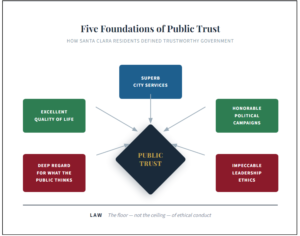
Santa Clara’s own research points the way. The City’s scientific surveys from 2006–2008 found that public trust ran highest when residents saw their government at its best — practicing impeccable leadership ethics, conducting honorable political campaigns, showing deep regard for what the public thinks, providing superb City services, and delivering an excellent quality of life.
In 2008, at the height of that work, 87% of residents said Santa Clara was going in the right direction. By 2024, only 40% did. Santa Clara built that trust once, on purpose, and then let it erode. The City can build it again — and this time, build it to last.
Why most cities never get there
Most cities never seriously try. Their ethics codes sit at one of two levels.
The common level is legal compliance: follow the law, file the disclosure forms, avoid the obvious forms of corruption — bribery, embezzlement, profiting from a contract. A smaller number reach a second level, adding aspirational “at our best” values that describe how good officials ought to behave.
Both levels matter. Neither is enough. And most cities never discuss ethics beyond corruption at all, because corruption is the only part of ethics they recognize.
The real shift: ethics is an organizational commitment
The development we propose moves past both levels to a third: public ethics as an organizational commitment.
Here is the distinction most cities miss. Public ethics is not personal morality, and it is not a private choice each official makes alone. It is a commitment the organization makes first — and then keeps by building the structures, norms, procedures, and policies that require and enable everyone within it to live up to that commitment.
A personal choice, or an organizational one?
This is where Santa Clara’s current leaders have it backward. At the July 11, 2023 Council meeting, as the Council again declined to create independent ethics oversight, Councilmember Hardy made the personal view explicit: “If someone is going to be ethical, it’s because they choose to be… I think it comes from within.”
Ethics, in this account, is a matter of individual character. The checks on it sit outside the organization — the FPPC, the District Attorney, a recall, and, ultimately, the ballot box.
That is precisely the misunderstanding that keeps cities from becoming trustworthy. The choice to run an ethical city is not a personal one. It is an organizational one. A council member’s private virtue is welcome — but it is not the point, and it is no substitute for an organization designed to produce ethical results no matter who holds office.
And the outside remedies Hardy names punish some wrongdoing only after the public has already been harmed. They do nothing to make the right decision easier, build a culture worthy of trust, or make unethical acts harder to conceal in the first place. That work belongs to the organization itself, and it cannot be outsourced to a prosecutor or an election.
How an organization keeps the commitment
An organization keeps that commitment in concrete ways:
- It sets structures, norms, procedures, and policies that make doing the right thing easier than doing the wrong thing.
- It builds a culture in which ethical conduct and public trust are expected, supported, practiced, and rewarded at every level.
- It designs its systems so that unethical actions are harder to take and harder to conceal.
Private ethics asks each person to be good. Public ethics builds an organization that does not depend on everyone being good — and that catches it quickly when someone is not.
What public ethics actually is
Public ethics is widely misunderstood, which is part of why so few cities develop it. Many people treat ethics as personal morality — honesty, kindness, obeying the rules — learned at home. Governments often reduce it to compliance: disclosure forms, regulations, and staying clear of obvious corruption.
But public ethics is not mainly about choosing between right and wrong. We are usually good at telling those apart. It is about responsibly handling conflicts among competing obligations, interests, and pressures in ways that keep the public’s trust.
The hardest public decisions rarely pit right against wrong. More often they force a choice between:
- competing public goods — right against right
- fairness and efficiency
- short-term needs and long-term consequences
- bad options and worse ones
- individual rights and the common good
- conflicting duties owed to different groups of people
- different ways of meeting the same fiduciary duty to the public
Those are problems of ethical judgment, not simply legal problems. They call for skill, self-awareness, transparency, public engagement, independent advice, and systems built to challenge bias and improve judgment.
What a City of Trust looks like in daily practice
In a City of Trust, the following are not slogans or one-time reforms. They are commitments the organization makes and structures it maintains.
The right people are at the table. Major decisions bring together elected officials, senior and relevant staff, capable Council committees, outside experts, independent perspectives, affected stakeholders, and the public. For complex, high-impact decisions — the Charter Review, for example — the City builds structures equal to the stakes and brings the public in early enough to shape the outcome, not just to react to it.
Ethical decision-making is a core practice. Before a final vote, decision-makers ask the questions ordinary processes skip: Does this build public trust? Does it treat equals equally? Does it meet what the people actually need? Does it protect the rights at stake and satisfy our fiduciary duties? Are there conflicts of interest — or the appearance of them — to resolve? A conflict arises whenever the duty to put the public first collides with an official’s obligations to family, friends, business partners, or major donors.
Public trust is actively built and protected. The organization practices transparency, including the proactive release of important records; fairness, treating people alike except for genuine differences in need or merit; and accountability, including the duty to show evidence that promises to the public were kept. It commits to continual ethics learning — naming mistakes and building the skills to avoid repeating them.
Participation is meaningful. Residents are invited to understand the issues, weigh in early, and influence outcomes — not to check a box after the decision is effectively made. Real participation produces stronger, fairer decisions and deeper trust.
Independent oversight protects the public. A trustworthy system does not rest on the goodwill of whoever currently holds office. Independent ethics oversight, transparency safeguards, and real accountability apply equally to every part of government — including the Stadium Authority and related entities — so standards stay consistent and conflicts of interest get caught.
Leadership sets the tone at the top. Culture flows downward. Elected officials and senior staff model ethical conduct, openness to criticism, and the willingness to correct mistakes — and they take responsibility for building the culture, not only for their own behavior.
Why this is so hard in Santa Clara
Santa Clara faces four major decisions — the Charter Review, the ethics code replacement, an independent ethics commission, and the Stadium “Put Right” — that will shape governance, accountability, and control of public resources for years. It faces them in an unusually difficult environment.
Multiple Civil Grand Jury reports have documented ethics and governance failures. A nationally recognized ethics program rose and then declined. Checks and balances weakened.
The Stadium at the center
At the center of much of the pressure sit Levi’s Stadium and the Stadium Authority. Much of the money generated by Stadium Authority operations flows back into the facility — operations, upkeep, turf replacement, public-safety costs above the cap, reserves, and a fund for demolition decades from now — obligations that in many private stadium deals would belong to the team.
The result is a governance environment in which public officials oversee a billion-dollar public asset tied to a powerful private tenant with a financial interest in nearly every major decision. Meanwhile, political action committees associated with the 49ers have spent millions in independent expenditures to shape Santa Clara elections and the Council majority.
Whether or not any single vote is improperly influenced, the combination of concentrated spending, large financial interests, and a pattern of tenant-favorable decisions makes genuine public accountability nearly impossible.
A weakened ethics culture
These structural pressures meet organizational ones. Ethical concerns get minimized, recast as political attacks, or applied selectively. Senior leadership has not consistently reinforced a culture in which ethical decision-making and public-trust responsibilities are expected and rewarded.
In October 2025, a public records request showed that in nearly three years the City Manager had issued no directive to staff about building an ethical organization. In that kind of environment, “go along to get along” becomes easier than asking hard questions, slowing a flawed process, or taking a principled stand.
None of these pressures alone decides an outcome. Together, they create a setting for public decision-making unlike that of most California cities — which is exactly why Santa Clara’s next decisions matter so much.
The choice
Santa Clara has done this before. It once showed that ethics and public trust can become ordinary government practice — not aspirational language, but skills, expectations, systems, and habits reinforced across the organization. It can do so again.
If it does, the payoff reaches beyond Santa Clara. People participate, cooperate, and serve more readily when they trust the integrity of those who lead. Trust makes hard problems easier to solve, partnerships easier to build, and conflict easier to lower. It makes public service more effective — and more satisfying — for the public and for the people who serve them. A city that rebuilds that culture becomes a role model, a learning community, and a demonstration site for ethical local government.
That is the promise, and the challenge, of becoming a City of Trust.
What kind of city Santa Clara becomes rests, finally, with its people. They alone hold the power to change the City’s direction — and to insist on a government worthy of their trust.
Join the conversation
Reading is open to everyone — no account needed. To comment on this article or share your own perspective, become a Public Trust Partner and sign in to the portal.
Join Public Trust Partners →