
Biases Revealed in Santa Clara’s Grand Jury Responses
By Dr. Tom Shanks | Public Trust Now | May 6, 2026
There’s an old story about an emperor who hired tailors to make him a magnificent suit of clothes. The tailors were con artists. They told the emperor the fabric was so fine that only wise people could see it. Foolish people would see nothing. So when the tailors held up empty air, the emperor praised the fabric — because admitting he couldn’t see it would mean admitting he wasn’t wise. His advisors did the same. The whole court pretended the clothes were real. Then the emperor paraded through the streets, and everyone applauded — until a child said what everyone could see: the emperor was wearing nothing at all.
Three Civil Grand Jury reports said Santa Clara’s emperor has no clothes. The emperor’s response? Question how the child was recruited, call the observation “rife with inconsistencies and biases,” and vote 5-2 that the clothes are fine.
The emperor has a strategy for this: don’t address what the child said. Instead, claim it’s all political. Tell everyone the child is part of an opposition faction trying to discredit the emperor. Once people are arguing about the child’s motives, nobody’s talking about the clothes anymore.
Three Santa Clara County Civil Grand Jury reports — “Unsportsmanlike Conduct” (2022), “Irreconcilable Differences” (2024), and “Outplayed” (2024) — investigated governance and ethics issues involving the City Council, the Stadium Authority, and the San Francisco 49ers. The findings were consistent and damning: the Council majority has repeatedly put 49ers interests ahead of the public’s, given away leverage in negotiations, and failed to provide meaningful oversight of a billion-dollar public asset.
The Council majority disagreed. Across all three reports, their responses followed a predictable pattern: accept the easy findings, reject the hard ones, attack the process, question other people’s integrity, and promise future action that never quite arrives.
What’s striking isn’t that they disagreed. Officials sometimes have legitimate reasons to push back on Grand Jury findings. What’s striking is how they disagreed — because the pattern reveals cognitive biases that the majority clearly doesn’t recognize in themselves. And those biases explain a great deal about how Santa Clara got from 87% of residents saying the City was going in the right direction in 2008 to 40% in 2024.
The Biases in Plain Sight
Self-Serving Bias
Across all three reports, the majority consistently interprets ambiguous facts in ways that make their decisions appear reasonable and justified. For example, in 2022, the City entered into a costly settlement after years of dispute. That same fact can be described as “protecting the General Fund” by avoiding further litigation—or as accepting an unfavorable outcome after failing to negotiate effectively. The Council consistently adopted the first interpretation.
What is missing is just as important. They never seriously consider the interpretation that casts their decisions in a negative light—even when an independent Civil Grand Jury, after months of investigation with access to documents the public cannot see, reached exactly that conclusion.
Self-serving bias operates automatically. It feels like objective analysis to the person experiencing it. That’s what makes it dangerous in public officials who control a billion-dollar asset.
Confirmation Bias
The majority accepts favorable findings without question and challenges unfavorable findings aggressively — even when both come from the same investigation, the same investigators, and the same evidence.
When the Civil Grand Jury finds that the General Fund was protected, they agree — no scrutiny, no pushback. When the same Grand Jury finds that the Council gave away leverage in settlement negotiations, they disagree — questioning methodology, challenging conclusions, attacking the process.
They never explain why one set of conclusions deserves trust and the other doesn’t. The only visible difference is whether the finding is flattering or unflattering.
In-Group Bias
The vote splits tell the story. For “Outplayed,” the bulk of substantive findings split 4-2, with Gillmor and Watanabe opposed to the majority’s responses. On “Irreconcilable Differences,” persistent 5-2 splits ran through the document. On “Unsportsmanlike Conduct,” the split was so deep that Gillmor and Watanabe filed a formal dissent agreeing with all Grand Jury findings.
When five people always reach the same conclusion on every issue — ethics, stadium management, personnel decisions, campaign finance — that’s not independent judgment. That’s group identity determining the answer before the question is asked.
Councilmember Jain’s characterization of the Grand Jury as pursuing a “grand conspiracy” and his claim that “it was Lisa Gillmor who was outplayed” reveals the frame: anyone who criticizes the majority is on the other team, and their conclusions are therefore suspect. This isn’t analysis. It’s tribalism.
Blind Spot Bias
The most important bias on this list — and the one that makes all the others invisible until you look closely.
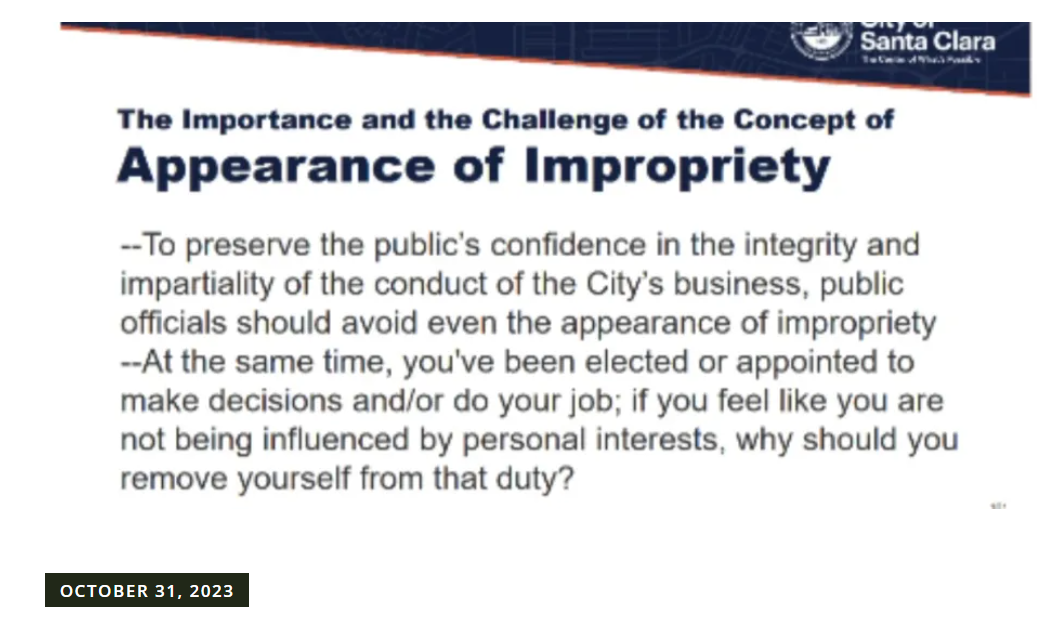
Councilmember Chahal has stated that every vote he’s taken has been for the people’s best interests. Councilmember Hardy says she doesn’t see anything illegal. They’re probably not being dishonest. They actually can’t see their own biases.
This is among the best-documented findings in behavioral science: people are far better at detecting bias in others than in themselves. The more confident someone is in their own objectivity, the more susceptible they typically are. The person who says “I’m not biased” is often exhibiting the bias they’re denying.
And nobody trained them to recognize this. In fact, the City Attorney’s first AB 1234 ethics training actively reinforced the blind spot by teaching officials that if they feel they don’t have a conflict of interest, they probably don’t. That’s the opposite of what the research says — and the opposite of what the law requires. (See slide above.)
Motivated Reasoning
When the Grand Jury documents that the 49ers’ economic impact claims are overstated — and an independent consultant validates the finding — the majority doesn’t engage with the substance. Instead, they shift to attacking the process.
Councilmember Jain questioned how grand jurors are recruited. He called the report “rife with inconsistencies, biases and oversights.” The focus moves from what the report found to why the report can’t be trusted.
This is classic motivated reasoning: starting from the conclusion you want — we made good decisions — and working backward to find reasons to dismiss evidence that says otherwise. The destination is chosen first. The reasoning follows.
Diffusion of Responsibility
Nobody on the majority takes personal responsibility for any outcome. The contracts were inherited. The settlements were necessary. The timing was unavoidable. Mr. Becker is “innocent until proven guilty.” The City Manager handles operations. The City Attorney provides legal advice.
Everyone points to someone else or to circumstances beyond their control. When responsibility is diffused across enough people and enough justifications, nobody is accountable — which is precisely the environment where ethical failures compound without correction.
Status Quo Bias
The majority’s response to many of the recommendations follows the same pattern: we’re already doing this, or we’ve already started, or we plan to address it soon.
The reality: one year after “Outplayed,” the community facility relocation has been postponed to 2027. Marketing oversight remains incomplete. The economic impact study is still in the planning stage. Nearly every commitment made in the formal response has stalled.
Status quo bias makes inaction feel like progress. Announcing an intention feels like taking action. Writing “will be implemented” in a formal response feels like implementation. The bias lets officials satisfy the requirement to respond without ever satisfying the requirement to change.
The Fundamental Attribution Error — In Reverse
When Grand Jury reports criticize the majority, they attribute the criticism to the critics’ “flaws”: bias, political motivation, poor methodology, a “grand conspiracy.”
When Gillmor or Watanabe raise concerns, it’s because they’re on the other “team.” When residents raise concerns, it’s a “small group of dissidents.” When the ethics consultant raised concerns, it must be “ethics for hire.”
They never consider the simpler explanation: maybe the criticism is accurate.
Meanwhile, they attribute their own behavior entirely to good intentions and sound judgment. Every vote was for the people’s best interests. Every decision was reasonable given the circumstances. Every settlement was the best option available.
The error works in both directions: other people’s criticism is always about their character flaws. Our own decisions are always about the situation we faced. This is the fundamental attribution error, and it runs through every Grand Jury response like a thread.
Why This Matters: You Can’t Self-Correct What You Can’t See
Every one of these biases is invisible to the person experiencing it. That’s not a character flaw — it’s how human cognition works. The research is overwhelming: people cannot reliably identify their own biases through introspection. The feeling of being objective is not evidence of being objective.
This is precisely why self-policing doesn’t work. And it’s precisely why the majority’s central argument against an independent ethics commission — that “existing checks and balances are enough” — is itself a product of the biases that make those checks insufficient.
Think about what “existing checks” actually means: The City Attorney works for the Council majority. The City Manager serves at their pleasure. The Governance and Ethics Committee is chaired by the majority. The FPPC takes years. Elections happen every two or four years. And 49er PAC money is overwhelming accountability at the ballot box.
Every check they point to is either one they control or one that operates too slowly to prevent damage while it’s happening. The ethics commission they keep rejecting is the one check they wouldn’t control.
What Would Actually Help
The solution isn’t to accuse officials of being biased and expect them to fix themselves. They can’t. None of us can. The solution is to build systems that compensate for the biases we all carry.
Independent ethics oversight — not controlled by the officials being overseen. An independent ethics commission can see what officials in the middle of decisions cannot see about themselves.
Structured decision-making processes — that require officials to consider evidence against their preferred conclusions before voting. The original Code of Ethics & Values included an ethical decision-making framework for exactly this reason.
Meaningful ethics training — based on behavioral science, not feel-good reassurance. Training that teaches officials to expect their own biases rather than to trust their feelings of objectivity. This type of training goes far beyond the Ethics Law Training that AB1234 requires.
Public transparency — not as a punishment, but as a check on motivated reasoning. When officials know their reasoning will be examined by informed residents, the quality of that reasoning improves. Transparency is the best antidote to self-serving bias.
Regular external review — independent assessments of governance decisions, not just when a Grand Jury investigates but as a routine function. The same way financial audits catch errors that internal reviewers miss, ethics reviews catch blind spots that self-assessment cannot.
Santa Clara built all of these things once. They worked. In 2008, the city earned 87% resident approval on the City’s direction. Then the systems were dismantled; the long-time ethics consultant left when ethics and public trust were no longer City priorities. Training was gutted, the citizen Ethics Committee was absorbed into a quarterly Council subcommittee, and the City was left with officials who genuinely believe they’re doing the right thing — because nobody is left to show them otherwise.
The Grand Jury responses are not just evidence of governance failures. They’re a textbook demonstration of why independent oversight exists — and what happens when it doesn’t.
Public Trust Now: City Government Of, By, and For the People
Join the conversation
Reading is open to everyone — no account needed. To comment on this article or share your own perspective, become a Public Trust Partner and sign in to the portal.
Join Public Trust Partners →