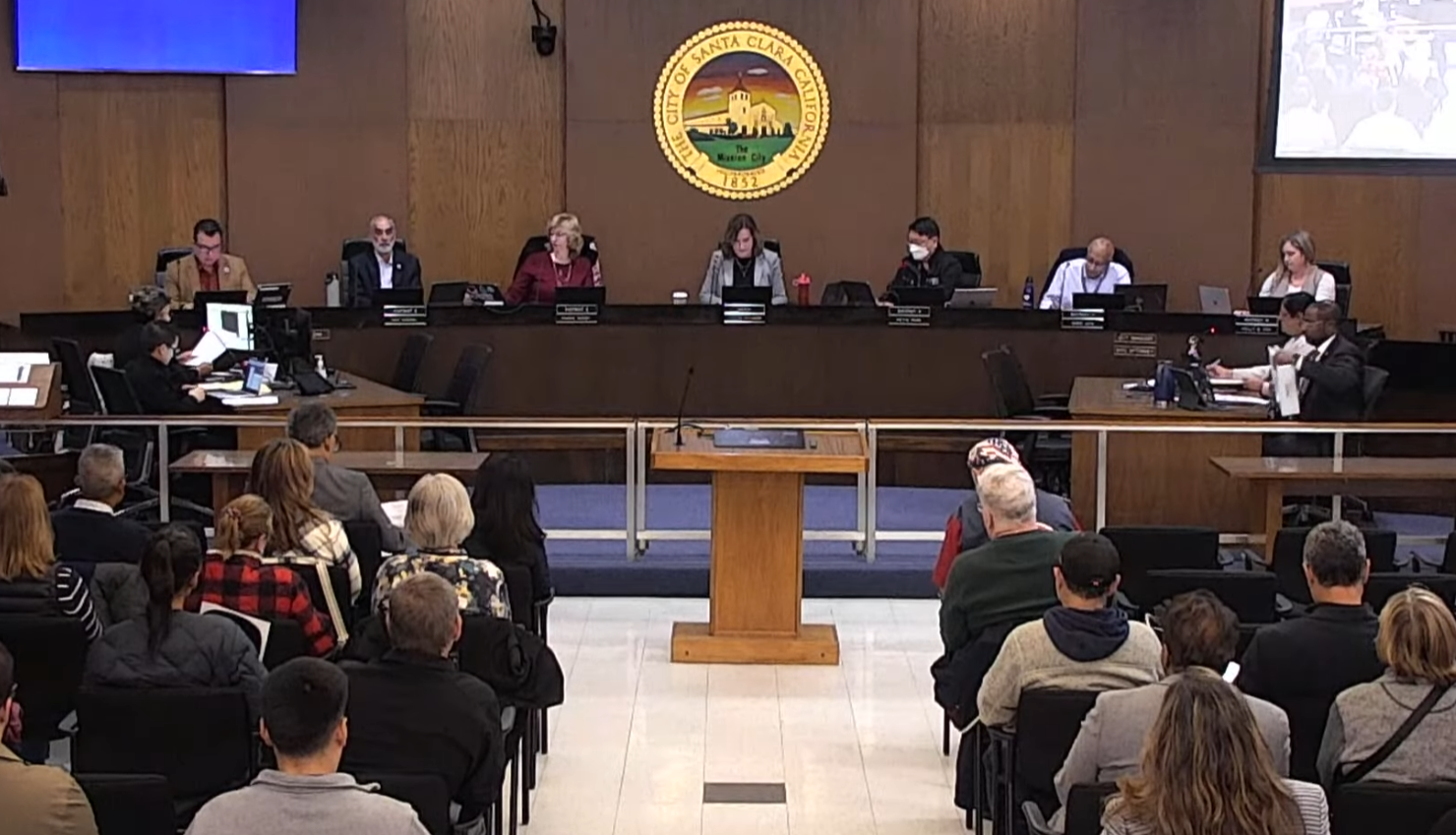
THE FACTS
Santa Clara plans carefully for unlikely disasters such as earthquakes and floods, but has no plan for a predictable and recurring event: elections dominated by unprecedented independent-expenditure spending.
This directly threatens a fundamental principle of democracy, self-government, which means that the voters—not a deep-pocketed private interest—decide who runs for office, what information is given to the public, and the culture of City Hall.
49er PACs pose the greatest risk to public trust in Santa Clara, as the mayor's position and two district seats open up in November 2026. After the Measure J Campaign and at least three elections, the 49er PACs have only failed twice: the Gillmor-Becker race in 2022, and the Cox-Guerra If the 49er PAC captures the Mayor's seat and retains the two districts, they will have captured six of seven seats, as well as the City Council Presider and ceremonial head of the City. That will leave CM Cox as the only member who does not owe her election to the 49er PACs.
THE FAILURE
The failure to seek a public solution to this situation is a serious city failing—compounded by firing the City Manager and City Attorney and leaving those positions vacant for extended periods.
Now, however, nearly three years into Mr. Grogan and Mr. Googins' tenures, the City still has no public plan, staff analysis, Council discussion, or public deliberation addressing the ongoing threat—indicating a governing culture that avoids politically sensitive issues involving the 49ers or a Council majority whose 57 meetings with 49er lobbyists in 2022 was an extremely effective on-boarding experience for new Council members. .
TRUSTWORTHY LEADERS WOULD: Acknowledge the threat publicly. Engage residents, experts, and ethical campaign specialists to develop an effective response that builds public trust—before the damage is done. No silence. No going dark.
WHAT WE'RE GETTING NOW: Nothing. No planning. No public discussion. No staff analysis. Just 5-2 votes for the 49ers agenda.
THE FACTS: The City's voluntary campaign expenditure program sets a limit on what candidates can spend on their political campaigns — $25,111 in 2024. The City asks candidates to agree voluntarily to that limit. Most candidates sign.
THE FINE PRINT: Independent expenditures don't count toward the cap.
So PAC-backed candidates can: (1) agree to the voluntary cap, (2) claim they "kept their promise" to limit spending, and (3) sit back and watch the PAC spend unlimited amounts on their campaigns — money they legally may not coordinate they know nothing about.
For three elections since 2020, 49er-funded PACs have spent $10+ million to secure 5 of 7 Council and Stadium Authority seats. The 2022 Santa Clara County Civil Grand Jury found that "...these five members can — and do — vote in a manner favorable to the SF 49ers."
2024 Case Study — The Race Against Kelly Cox: 56 to 1. PAC spending to defeat Kelly Cox: $391,000. Kelly Cox's available campaign funds: $7,000. She won anyway. There may be useful lessons to be learn from that race.
TRUSTWORTHY LEADERS WOULD: Suspend or cancel the voluntary spending program until independent expenditures are addressed. A program that creates a false appearance of fairness while rewarding those who benefit from the loophole kills public trust.
WHAT WE'RE GETTING NOW: Nothing. No changes. The same program that enables deception continues unchallenged.
THE FACTS: From 2002 to 2016, the Vote Ethics Program held candidates publicly accountable for their campaign behavior. Candidates signed ethics pledges from both the State and the City. The program provided training in campaign ethics, and encouraged candidates to conduct issues-oriented, honest, fair, and respectful campaigns that gave voters the information they needed to vote for a council they trusted.
The Program also used flyers, Inside Santa Clara, utility bill inserts, short videos, even the City calendar to show voters how to tell what an ethical and unethical campaign looked like. Candidates saw examples of these materials prior to conducting their campaigns.
The program earned the Helen Putnam Grand Prize Award for Enhancing Public Trust from the League of California Cities and recognition from the United Nations as a global best practice.
After the 2016 election, it was allowed to die. No Council member asked to continue it. No staff member was directed to sustain it. No consultant was hired to advise candidates and facilitate the program. The program that built public trust in eight consecutive elections simply vanished — just as 49er PAC spending began to dominate Santa Clara campaigns.
Without Vote Ethics, voters lost the only independent tool they had to evaluate campaign conduct. What replaced it? Millions in PAC-funded mailers — designed not to inform, but to manipulate. No City ethics pledges based on the Code of Ethics & Values, just a vague State Code. Since no one "publicly repudiated" attack ads, the majority violated even that watered-down Code. No monitoring. No accountability for what candidates say or what PACs say on their behalf.
TRUSTWORTHY LEADERS WOULD: Restore and strengthen voter education programs that help residents evaluate candidates on character and integrity — not just promises. Welcome independent monitoring of campaign conduct.
WHAT WE'RE GETTING NOW: We will soon face an arms race of PAC-funded mailers with no accountability for accuracy, fairness, or the damage they do to democratic self-governance. For now, we're getting silence, while the 49er agenda is alive and well.
THE FACTS: Over 14 years, Santa Clara's leaders eliminated every program, position, and process designed to build and protect public trust:
Ethics consultant position — eliminated (2015)
Vote Ethics Program — ended (2016)
Democracy Santa Clara — ended (2019)
Monthly citizen Ethics Committee — merged into a quarterly Council subcommittee (2019)
Ethics training for staff and officials — abandoned
Public Trust Impact Report — rejected three times (2009, 2010, 2011)
None of this was done through a public vote. None was announced. The ethics infrastructure was quietly dismantled piece by piece while the City was distracted by stadium issues.
TRUSTWORTHY LEADERS WOULD: Maintain and strengthen the systems that build public trust. Treat ethics infrastructure as essential, not optional.
WHAT WE'RE GETTING NOW: A City Hall with no ethics consultant, no ethics training, no public trust program, no accountability mechanism — and resident confidence that dropped from 91% to 40%.
ACCORDION ITEM 5
TITLE: Eliminated prevention — leaving only crisis and politics
CONTENT:
THE FACTS: Santa Clara's ethics program was designed to prevent problems before they became crises. The ethics consultant worked with staff and officials to identify and resolve ethical issues early — before they became scandals, lawsuits, or front-page news.
Without prevention, all that's left is crisis management and political maneuvering. Every ethics issue now becomes a political fight rather than a professional problem to solve. The result: three Civil Grand Jury reports (2016, 2022, 2024) documenting the same problems getting worse.
TRUSTWORTHY LEADERS WOULD: Invest in prevention. Rebuild the ethics infrastructure that catches problems early. Treat the Grand Jury recommendations as a roadmap, not a nuisance.
WHAT WE'RE GETTING NOW: Crisis after crisis. Political censure used as a weapon. No prevention. No early intervention. No learning from mistakes.
ACCORDION ITEM 6
TITLE: Replaced public accountability with majority-led political censure
CONTENT:
THE FACTS: Without an independent ethics process, the Council majority has turned "accountability" into a political weapon. Censure votes follow party lines — the same 5-2 split that defines every 49ers-related vote.
Real accountability requires independence, impartiality, due process, and consequences that apply equally to everyone. Political censure is none of these. It's the majority punishing the minority for disagreeing.
TRUSTWORTHY LEADERS WOULD: Establish an independent ethics process — with due process protections, impartial investigation, and consequences that apply to everyone equally regardless of political alignment.
WHAT WE'RE GETTING NOW: A majority that uses censure as a political tool while blocking the independent Ethics Commission that three Civil Grand Jury reports recommended.
ACCORDION ITEM 7
TITLE: Redefined ethics as "follow the law" compliance
CONTENT:
THE FACTS: In July 2023, the Council approved hiring a consultant to "review ethics documents." That consultant worked for a year with Staff behind closed doors to produce a replacement ethics code. No document review. No public input.
The replacement is a "follow the law" compliance code that applies only to the City Council — not other elected or appointed officials, and not City Staff. It reduces 8 values to 6. It eliminates all behavioral standards. It does not apply to the Stadium Authority.
This is exactly the kind of code the City rejected twenty-five years ago — a 1960s-era approach that provides no guidance in difficult situations. Following the law is the floor, not the ceiling. Ethics asks more.
A public records request for the contract and communications showing how "review" became "replace" was delayed six times over three months and closed without providing the documents.
TRUSTWORTHY LEADERS WOULD: Follow the open, inclusive process that made the original code a state model. Engage all stakeholders. Build consensus. Strengthen the code — don't gut it.
WHAT WE'RE GETTING NOW: A closed-door rewrite that abandons 25 years of progress. Discussion scheduled at an obscure Council committee meeting at 10 a.m. on a weekday.
ACCORDION ITEM 8
TITLE: Treated public trust as an afterthought rather than a priority
CONTENT:
THE FACTS: The Stadium Authority's own governing documents tell the story: 2,000+ words on budget procedures to protect creditors and the 49ers. Fourteen words on ethics — with no enforcement. Approved in 2018 with typos and a repeated paragraph no one has bothered to fix. That's how seriously they take ethics and public trust.
The Stadium Authority has never adopted the City's Code of Ethics & Values. It has never had its own ethics code. The same five council members who vote as a bloc for 49ers interests on City Council also control the Stadium Authority.
Three Civil Grand Jury reports recommended ethics reforms for stadium governance. None have been implemented.
TRUSTWORTHY LEADERS WOULD: Apply the same ethical standards to stadium governance as city governance. The same people serve both — the standards should follow them.
WHAT WE'RE GETTING NOW: Fourteen years of operating a billion-dollar public asset with zero ethical guardrails. The same conflicts. The same closed-door decisions. The same 5-2 votes.
ACCORDION ITEM 9
TITLE: Exposed their real beliefs about ethics — and why an independent ethics commission is essential
CONTENT:
THE FACTS: The Council majority has rejected or delayed an independent ethics commission for years — despite three Civil Grand Jury reports recommending one. On July 11, 2023, it was Councilmember Becker who made the motion to reject it — arguing it would "just be used as a political weapon." Becker had been indicted for felony perjury three months earlier, for leaking a confidential Grand Jury report to the 49ers' top lobbyist and lying about it under oath. He would have been the first case an ethics commission investigated. Instead, he voted to make sure one never existed.
The councilmember facing felony charges for betraying the public trust cast the vote to block the one independent body that could have held him accountable. And his colleagues let him.
Residents asking for accountability and transparency is a "political weapon" — directed at them. That tells you everything about how this majority views the relationship between the people and their government.
THEY ASKED WHERE THE ETHICS PROGRAM WAS — AFTER THEY LET IT DIE
At that same July 2023 meeting, Council members asked where the ethics program was during the ugly 2018 and 2020 elections — as if its absence proved ethics programs don't work.
The answer: City staff ended it, and the Council did nothing to save it. After City Clerk Rod Diridon Jr. resigned in February 2018, the Acting City Clerk argued it was "legally problematic" for the City to organize candidate forums — killing the Democracy Santa Clara program that had earned a Helen Putnam Grand Prize and United Nations recognition. The Council never directed staff to continue it.
But that wasn't all. In July 2018, the Council stripped the elected City Clerk of nearly all duties by ordinance — despite the 2017 Charter Review Committee unanimously opposing the change — gutting the position without a public vote. In 2019, they merged the monthly citizen Ethics Committee into a quarterly Council subcommittee controlled by the majority. And in 2025, they spent the year reducing public comment opportunities — two minutes on agenda items, 72 hours' notice of what's coming.
Kill the program. Blame it for not being there. Silence the people who might object.
THE CHECKS THAT DON'T CHECK
Their argument: the FPPC, the recall process, and elections provide enough checks and balances. None are timely or effective:
The FPPC takes years and has no authority over local ethics codes. Recalls require thousands of signatures — by which time the damage is done. Elections happen every two or four years, and 49er PAC money can overwhelm accountability at the ballot box. The City Attorney works for the majority. The City Manager serves at their pleasure. The G&E Committee is chaired by the majority.
The ethics commission they keep rejecting is the one check they wouldn't control.
Mr. Chahal has stated that every vote he's taken has been for the people's best interests. Residents can judge that claim against the record on this page.
THE CITY MANAGER'S SILENCE
Building and sustaining an ethical organization is one of the key responsibilities of public sector leaders. It is the obligation of the City leadership to cultivate an organization where ethical behavior is encouraged, identified, rewarded, and sustained. — City Manager James Keene, City of Palo Alto
As of October 2025, after three Civil Grand Jury reports documenting ethical failures, City Manager Jovan Grogan has issued zero directives concerning ethics. No memo to staff. No reminder about the Code of Ethics & Values. Nothing.
He and the City Attorney signed NDAs giving power to the 49ers and the Bay Area Host Committee. Neither raised a word about perceived conflicts of interest from $10+ million in PAC money or 57 meetings between the majority and 49ers lobbyists in their first year. Public records tell the rest of the story: friends, business partners, and a councilmember leaking confidential reports and discussing the City's legal strategy with the team's lobbyist.
Silence in the face of documented ethical failures isn't neutrality. It's participation.
THE BECKER CASE: PROOF THE CHECKS DON'T WORK
Becker was indicted in April 2023. He refused to resign. His colleagues made him Vice Mayor and let him vote on every 49ers-related issue for 20 months. He was convicted in December 2024. The jury deliberated less than three hours.
An independent ethics commission could have acted within weeks — suspending him from 49ers-related votes to protect the integrity of City decisions. Instead, there was no mechanism to do anything. Twenty months of compromised governance. That's what "enough checks and balances" looks like.
THE CULTURE THEY'VE CREATED
This is what City Hall has become: ethics issues aren't addressed — they're ignored, attacked, or dismissed. Residents who raise concerns about accountability are characterized as a small group of disaffected people making claims with no evidence — despite three Civil Grand Jury reports documenting exactly what those residents have been saying.
When the elected Police Chief asked the District Attorney to investigate the chilling effect this culture was having on the public's willingness to speak up, the Council majority's response wasn't to address the problem. It was to launch an elaborate process to make the Police Chief an appointed position — appointed by the same City Manager whose silence on ethics has enabled everything documented on this page.
That's the pattern: don't fix the problem. Eliminate the person who pointed it out. City Manager, City Attorney, Police Chief — anyone whose independence might inconvenience the majority gets fired, silenced, or restructured out of existence.
And on July 11, 2023, when Becker — three months into a felony indictment — led the diatribe against an ethics commission, his colleagues didn't just let him. They voted with him. The majority followed the lead of a man under criminal charges to kill the one body that might have held any of them accountable.
Luckily, the people saw through at least one of these maneuvers. The Charter Review Committee collected roughly 250 valid questionnaires on making the Police Chief and City Clerk appointed — which the majority ignored, along with dismissing some 6,000 spam responses that had flooded the process. When the measure finally reached the ballot, the voters confirmed exactly what those 250 questionnaires had indicated: 75% opposed. The people understood what the majority was really doing, even if the majority thought they wouldn't notice.
And this is only the tip of the iceberg. Behind closed doors — in NDAs the public can't see, in closed sessions that report "no action," in settlements negotiated without independent analysis — there is more. The question isn't whether Santa Clara will hit the iceberg. It's whether anyone on the bridge is watching.
TRUSTWORTHY LEADERS WOULD: Establish an independent ethics commission with authority to investigate complaints, hold hearings, and recommend consequences — anchored in the Charter so it can't be quietly dismantled. Welcome accountability rather than call it a weapon.
WHAT WE'RE GETTING NOW: A consultant "studying" the idea with no public input, no document available for public review, and a Council majority that has already rejected the concept twice — because accountability, to them, is an attack.
ACCORDION ITEM 10
TITLE: Leave ethics and public trust unprotected in the Charter
CONTENT:
THE FACTS: Without charter protection, ethical leadership, good governance, and public trust will remain entirely in the hands of this and future Councils — the same officials who over 14 years quietly dismantled Santa Clara's ethics program and built a City Hall culture that does not practice independence, impartiality, transparency, or accountability.
Charter-level protection means voters — not a council majority — decide whether ethics infrastructure stays or goes. Without it, the next council can finish what this one started.
TRUSTWORTHY LEADERS WOULD: Make ethical leadership and public trust a permanent part of City Hall culture by anchoring in the Charter an integrity-focused ethics code, practical behavioral standards, an independent and effective accountability structure, dedicated staffing, and other best practices.
WHAT WE'RE GETTING NOW: A Charter Review that doesn't include ethics. An ethics code replacement done behind closed doors. And a proposed Ethics Commission with no charter protection — leaving everything up to whichever Council the 49ers' PAC money selects next.
CLOSING SECTION — AFTER THE ACCORDION
WHERE WE WERE. WHERE WE ARE. WHAT'S AT STAKE RIGHT NOW.
You've now seen what Santa Clara built — and what's been dismantled. The question isn't whether this matters. The question is what happens next.
Three decisions are being made right now that will shape Santa Clara's future for generations:
The Charter Review — The City Charter is being rewritten. This is where ethics protections either get anchored permanently or left vulnerable to the next council that finds them inconvenient.
The Ethics Code — The Code of Ethics & Values that took years of community input to build is being replaced behind closed doors by a law firm — not an ethics expert — with no public participation. The original RFQ called for a review. It became a replacement. No one has explained why.
The Ethics Commission — Three Civil Grand Jury reports have recommended one. The Council has rejected the idea twice. A consultant is now "studying" it with no public input and no documents available for public review.
These aren't abstract policy discussions. These decisions determine whether the people of Santa Clara have any independent check on the power of their own government — or whether every safeguard remains in the hands of the people it's supposed to safeguard against.
WHAT YOU CAN DO RIGHT NOW
Make your voice heard. Send a letter to the Mayor and City Council telling them public trust matters to you. We've drafted one you can personalize and send — or we'll send it on your behalf.
Join the Public Trust Partners. Sign up with a PEN Name to participate in a verified community of Santa Clara residents committed to ethical governance. Your identity stays protected. Your voice gets heard.
Stay informed. Subscribe to our email updates to track what's happening with the Charter Review, Ethics Code, and Ethics Commission — and know when your input matters most.
Volunteer. Help with research, writing, outreach, or event planning. This work takes a community.
Share what you know. If you have information about governance decisions that the public should see, we want to hear from you — securely and confidentially.
Join the conversation. Participate in our community forums where residents discuss what ethical governance looks like and how to get there.
THE BULLDOZER IS IN YOUR FRONT YARD
Twenty-five years ago, when this work began, long-time Santa Clara residents told me not to get my hopes up about people getting involved in local government. "People in Santa Clara don't get involved," they said, "unless there's a city bulldozer in the front yard. It's already knocked down the front fence and it's on its way to the front door."
[BULLDOZER IMAGE]
If you've read this far, you can see it. The bulldozer is in your front yard and on its way to your front door.
If you want ethics to be central to the decisions the Council makes — not an afterthought, not a talking point, not something to be studied and shelved — now is the time.
If you want an independent ethics commission that provides training, celebrates ethical leadership, offers guidance before problems arise, and enforces standards when necessary — now is the time.
If you want them to build on the current Code of Ethics & Values rather than gut it, include the Stadium Authority under the same ethical standards as the rest of the City, and anchor the ethics program, the ethics code, and the ethics commission in the Charter so that no future council can quietly dismantle them — now is the time.
Stand outside your front door. Protect your home. Protect everyone else's home. Protect the city you love — and demand the government you deserve.
STATUS NOTES
Items 1-2: Finalized
Item 3: Content drafted above (Vote Ethics / fair campaigns) — needs Tom's review
Items 4-8: Finalized
Item 9: Finalized (includes Becker opening, "killed the program" section, checks that don't check, City Manager's silence, Becker case study, culture section with Police Chief and 75% voter opposition, iceberg closing)
Item 10: Finalized (charter protection)
Closing section: Finalized (three decisions, action items, bulldozer)
THE FACTS: Over 14 years, Santa Clara's leaders eliminated every program, position, and process designed to build and protect public trust:
Ethics consultant position — eliminated (2016)
Vote Ethics Program — ended (2016)
Democracy Santa Clara — ended (2018)
Monthly citizen Ethics Committee — merged into a quarterly Council subcommittee (2019)
Ethics training for staff and officials — abandoned, with a gap in the State mandated training
Public Trust Impact Report — rejected three times (2009, 2010, 2011)
With the exception of the Ethics Committee change, none of this was done through a public vote. None was announced. The ethics infrastructure was quietly dismantled piece by piece while the City was distracted by stadium issues.
TRUSTWORTHY LEADERS WOULD: Maintain and strengthen the systems that build public trust. Treat ethics infrastructure as essential, not optional. Train everyone in ethical decision-making and in the specific requirements of the ethics code. Discuss the ethics issues involved in City decision-making and use ethics decision-making skills to explain decisions.
WHAT WE'RE GETTING NOW: A City Hall with no ethics consultant, no ethics training, no public trust program, no accountability mechanism — and resident confidence that dropped from 91% in 2006 to 40% in 2024
THE FACTS: Over 14 years, Santa Clara's leaders eliminated every program, position, and process designed to build and protect public trust:
**Ethics consultant position—eliminated (2016)
**Vote Ethics Program—ended (2016)
**Democracy Santa Clara—ended (2018)
**Monthly citizen Ethics Committee—merged into a quarterly Council subcommittee (2019)
**Ethics Code training for staff and officials—replaced by every other year AB1234 training in ethics laws (2016)
**Public Trust Impact Report—new program proposed, rejected three times (2009, 2010, 2011)
**Program Ownership--from City Council to no one; from City Manager to no one.
Until this current Council, no Council wanted to be known as the Council that practiced politics without principle, presided over the death of an award-winning Ethics Code, and was creating a city government culture where public ethics was ignored unless it was used as a political weapon, and where public trust was an afterthought.
Until this current Council, none of the dismantling was preceded by a public discussion and vote (with the exception of the ethics committee merger). None was announced. This was a joint effort by the City Council majority and senior City staff.
TRUSTWORTHY LEADERS WOULD: Maintain and strengthen the systems that build public trust, believe that the ethical behavior and decision-making is part of the fiduciary duty the Council and staff have to the residents and business owners. Would preserve and protect independence, impartiality, and accountability. Treat ethics infrastructure as essential, not optional. Discuss ethics principles involved in decisions.
WHAT WE'RE GETTING NOW: A City Hall with no ethics consultant, no ethics training, no public trust program, no accountability mechanism--even worse, a City Hall where no one ever talks about ethical leadership, good governance, or public trust--unless it comes up in a Civil Grand Jury Report. It's no wonder that 91% of residents believed the City was going in the right direction in 2006. By 2024, the number dropped to 40%.
THE FACTS: Without an independent ethics oversight process, the Council majority has turned "accountability" into a political weapon. Censure votes follow majority-minority splits—the same 5-2 split that defines every 49ers-related vote and the official City response to the three Grand Jury Reports.
Real accountability requires independence, impartiality, due process, and consequences that apply equally to everyone. Political censure in Santa Clara today is none of these. It's the majority punishing the minority for disagreeing or, more generally, for being "them" for those whose world divides neatly between "us" and "them."
TRUSTWORTHY LEADERS WOULD: Establish an independent ethics process—with non-political appointments, due process protections, impartial investigation, and consequences that apply to everyone equally regardless of political alignment, with the resources and staff to do an exceptional job, and with a mandate to build public trust.
WHAT WE'RE GETTING NOW: A majority that uses censure as a political tool while blocking the independent Ethics Commission that three Civil Grand Jury reports recommended. The majority censures the minority, but refuses to censure other majority members who have done the same or worse behaviors. The majority is then frustrated when the censured behavior continues and the relationships worsen.
THE FACTS THEN: In 1998, Santa Clara rejected its 1960s-era compliance code because it wasn't practical, didn't help anyone make difficult decisions when public trust was at stake, inspired no one to improve.
The City chose instead to build one of the first consensus-driven, integrity-focused codes in the State. Working with residents over two years (1998-2000), the City developed the Code of Ethics & Values grounded in eight core values with 29 specific behavioral indicators. It applied to everyone in city government. It was character-based: "As a representative of Santa Clara, I am trustworthy, acting with the utmost integrity and moral courage."
The consensus process was integral to its success. Since the goal of the ethics program was to increase public trust, it made logical sense to ask residents what government behaviors built or destroyed trust. Having identified trustworthy behaviors, it made logical sense that the public would own those values and watch out for them.
Leaving the public out of the ethics code reform process, as City staff has, or involving them after the consultant has provided an initial report, revised it based on staff input, and then presented it for public input and Council approval (the process written into the RFQ for the ethics commission study
Once the Code went into effect, 91% of residents said the City was going in the "right direction" and Santa Clara's process became a state model. A companion 16-page Behavioral Standards document (2008) let residents evaluate officials against specific standards — don't promise your vote before facts are known, don't make back-room deals, don't give preferential treatment to campaign donors.
THE FACTS NOW: Two years ago, in July 2023, Council approved hiring a consultant to review the City's ethics documents and recommend next steps. Updating was necessary because the Stadium wasn't built until 2014Eight months passed before City staff hired anyone — and instead of an ethics consultant, they hired a law firm that defends employers against their employees' complaints.
City staff--we hav, worked behind closed doors for a year with zero public input and produced not a review but a replacement. It was presented in March 2025 at a 10 a.m. weekday meeting of the Governance and Ethics Committee (Chair Jain, Mr. Chahal, and Mr. Park, City Manager, and City Attorney, and other staff.) The agenda labels its own document "REPLACEMENT TO: City Code of Ethics & Values."
The replacement reduces 8 values to 6, eliminates all 29 behavioral indicators, and applies only to the City Council—not the Police Chief, City Clerk, commissioners, Staff, or Stadium Authority. It replaces "I am trustworthy, acting with the utmost integrity and moral courage" with "Elected officials must comply with all federal, State, and City laws." It eliminates the entire 16-page Behavioral Standards document. Following the law is the floor. This code makes the floor the ceiling.
Since this Council has already gone on record saying that the current enforcement mechanisms are more than enough, it's an easy step to say, "Our code recommends adherence to the law. No need for us to have a separate enforcement mechanism."
And what are City officials who are subject to this code supposed to do with it: Sign it and send back the signature page, saying that you've read it. No training on what the values mean in practice. No discussion of how they apply to your job or to public trust. No scenarios showing how these principles work in real decisions. Read it, sign it, done. That's not an ethics program. That's a liability shield.
WHY DOES THE CODE NEED REPLACING? Since the consultant provided no review of current ethics documents, she offered no rationale for replacing the code with a compliance code and replacing the Behavioral Standards for dealing with the people with 8 rules for dealing with the Staff.
Why not build on the current code, strengthening it with 25 years of real-world experience. And including the Stadium Authority for the first time. If this current Council is to learn the skills of ethical decision-making and ethical leadership, it would be reasonable to apply those skills to their entire job and to the whole City Council meeting, instead of announcing during the Stadium Authority part of it, "This section of the meeting has no ethics guardrails."
And no one seems to have considered the irony: a code that is supposed to build public trust was rewritten without ever asking the public what behaviors they consider trustworthy. The consensus process that made the original code successful was the first thing eliminated.
TRUSTWORTHY LEADERS WOULD: Start with the code that earned 91% approval for the City's direction. Hire an ethics consultant, not an employment lawyer — someone like JoAnne Speers of S2 Ethics Strategies, who as Executive Director of the Institute for Local Government wrote the state's ethics code development guide and has spent 35 years helping agencies build values-based programs. Strengthen the code with stadium and campaign finance examples. Give the code an owner — an independent Ethics Commission with an advisory committee of residents, senior leadership, Council reps, commissioners, and department champions. Treat ethics as a blueprint for changing direction, not a document to sign and forget.
WHAT WE'RE GETTING NOW: The same kind of code Santa Clara rejected in 1998 — because it wasn't practical, didn't help anyone make difficult decisions, and inspired no one to improve. A code that asks "Can we get in trouble for this?" instead of "Are we at our best?" Read it, sign it, done — written by an employment lawyer to shield liability, not build public trust.
Opus 4.6
Extended
Claude is AI and can make mistakes. Please double-check responses.
Lorem ipsum dolor sit amet, consectetur adipiscing elit. Nullam commodo velit ex, non ultrices leo auctor at.
Lorem ipsum dolor sit amet, consectetur adipiscing elit. Nullam commodo velit ex, non ultrices leo auctor at.