Is Santa Clara Moving
in the Right Direction?

The City of Santa Clara once led California in municipal ethics. Its nationally recognized ethics program was studied, copied, and trusted by residents. 

In 2008, 87% of Santa Clara residents said the City was going in the right direction.

Today, the ethics program has largely disappeared. In 2024, just 40% said the City's direction was the right one.

Now Santa Clara faces a once-in-a-generation decision point that will either put the city on a positive path, or continue it  toward politics without principle, government without ethics, and a city without trust. The stakes couldn't be higher. 

In the next few months, will Santa Clara's government:

  • Strengthen, weaken, or replace Santa Clara's values-based Code of Ethics & Values and Behavioral Standards
  • Create independent ethics oversight designed to succeed, adopt a weaker system designed to fail, or reject oversight altogether
  • Embed permanent public trust, ethical leadership, and good governance protections in the City Charter
  • Apply those protections equally to the city, the Santa Clara Stadium Authority, and any other joint powers and public/private partnerships.

Two questions have the power to turn the city around:

  • What is the right thing to do for the people?
  • What decision will most build public trust? 

The old model of civic engagement — trust your government to do its job, pay attention during elections, then return to your own life — works only when the government is trustworthy. Three Civil Grand Jury reports have documented ethics and governance failures and recommended specific ways to fix them. Nothing has changed. The city is proceeding exactly as before.

As it stands today, these three opportunities—charter review, ethics code revision, ethics commission—will do nothing to rebuild public trust unless the public intervenes.

Thomas Jefferson understood what that requires. "Whenever the people are well informed," he wrote, "they can be trusted with their own government; that whenever things get so far wrong as to attract their notice, they may be relied on to set them to rights."

Things have gotten that far wrong in Santa Clara. Public Trust Now is here to make sure residents have what they need to turn the City around — independent, verifiable facts and analysis: city policies, decisions, and behaviors examined through the lens of ethics and public trust,  so residents can draw their own conclusions about whether their best interests are being served.

We also provide a space for constructive community discussion and deliberation. The problems facing Santa Clara are complex and have taken years to develop. Turning the city around — especially when its current government has shown no desire to do so — will be hard work. It will require the best thinking the Santa Clara community can bring: creative imagination, principled solutions, and genuine respect for divergent views. Everyone has a part of the solution. Great ideas can come from anywhere. Everyone can teach, and everyone can learn.

That is the purpose of Public Trust Partners — a secure community forum where residents can get informed, understand the stakes, engage in civil discussion, share solutions, reach consensus, and work together to create the most trusted city government in California.

What Kind of City Will We Be?

From 1998 to 2012, the City of Santa Clara asked residents the same question in many different situations: When your city government is at its best, earning your trust, how do its leaders act?

These are the answers Santa Clara residents gave:  At their best, Santa Clara's officials: 

  • Tell the truth
  • Do the right thing
  • Value ethical leadership
  • Work at all times only for the people's best interests
  • Engage and listen to the people
  • Conduct fair election campaigns
  • Are careful stewards of the people's money
  • Provide high quality, affordable city services
  • Manage public assets—including Levi's Stadium—for the people's benefit
  • Are accountable—and show evidence of promises kept.

Those answers became Santa Clara's core values and the heart of the Santa Clara Code of Ethics & ValuesAs a representative of Santa Clara, I will be ethical, professional, service-oriented, fiscally responsible, communicative, collaborative, and progressive. The Code included the core behaviors involved in each value. The City then turned those values into clear behavioral standards: specific words and actions that showed everyone what the values looked like in practice, and behaviors to avoid.

That work earned Santa Clara national and international recognition. It led to 87% of city residents saying the City was going in the right direction.

Today the training and other programs and people who supported the Code are gone. Now the Code itself is under threat. Recently, a public records request showed that the City has been working behind closed doors since March 2024 to get rid of the award-winning values-based Code of Ethics & Values.

The lawyer consultant the City hired to review the ethics documents came to her March 2025 meeting with the Governance & Ethics Committee, a Council subcommittee that usually meets at 10 a.m. on Monday mornings, not with a review, but with a draft replacement Code for the City Council. (It does not apply to the other elected officials, City Commissioners, or City Staff.) 

While the current Code is a values-based Code that sees the law as the floor but not the ceiling and encourages the highest standards of ethics, the replacement Code is a rules-based "follow the law" compliance Code, like the City's old code, rejected 25 years ago because it didn't help anyone make difficult decisions that built public trust.

Some of the good government behaviors at the top of this section are mandated by law, but most are not. The law is what we must do; ethics is what we ought to do.  This is why the City defined ethics as the way city officials and the city organization act when they are at their best earning the public's trust.  Good government behaviors aren't ideals invented by reformers or dreamers. They're how residents said they expect city leaders to act when they are trustworthy. Some city officials have dismissed this list as fit only for dreamers, saints, and fools — not pragmatic politicians who live in the real world.

The people of Santa Clara disagree. The City created good government once--and it lasted for a dozen years. Residents have the right to expect it again.

What Changed--and Why It Matters Now?

In 2008, Santa Clara's nationally recognized Code of Ethics & Values had been in place for eight years—and it showed. Eighty-seven percent of residents said the city was headed in the right direction.

Then the 49ers arrived. In 2010, the team spent $4.3 million to pass Measure J — winning with 58% of the vote.  What the Mercury News called "an overwhelming margin" is a questionable conclusion since stadium approval from the 14,628 people who voted for it is roughly 12% of the city's population.

What team owners learned through that campaign, though, they applied directly to City elections after the City tried in 2019 to fire the 49er affiliate Manco, whom the City pays to manage the stadium all year and book non-NFL concerts and events after football season.

Through 2024, the 49ers spent approximately $15.5 million on Santa Clara elections, creating a council and Stadium Authority supermajority that consistently votes, the Civil Grand Jury found in 2022, "in a manner that favors the team."  The ethics program was quietly dismantled. Three Civil Grand Jury reports documented the damage. The majority dismissed the first outright;  they have delayed, deflected, or hired consultants who have delayed action on the rest.  One recommendation, to create a useful community space as promised in 2010 has been delayed until 2027 after the Superbowl and FIFA, again putting the Team's agenda ahead of the public's. 

Much of the dismantling happened out of public view—a replacement ethics code developed in secret, a stadium settlement signed the morning after a closed Council meeting that had "no reportable action," and more than 57 private meetings between 49ers-aligned council members and the team's lobbyists, logged on five public calendars only as "SCSA/49ers."  From the 49ers' perspective, those 57 meetings were a highly effective on-boarding for the new majority, leading to their firing the City Attorney and City Manager. changing the Stadium curfew rules, and a Tea-proposed legal settlement.

By 2024, only 40% of residents said the city was headed in the right direction — a collapse of nearly 50 points in a measure closely linked to public trust. Santa Clara last formally surveyed residents on public trust in 2008. It hasn't since. It should.

This is what happens to a city when ethics is ignored, treated as a political weapon, and has no effective, timely, and independent ethics oversight. 

What Builds Trust in Santa Clara

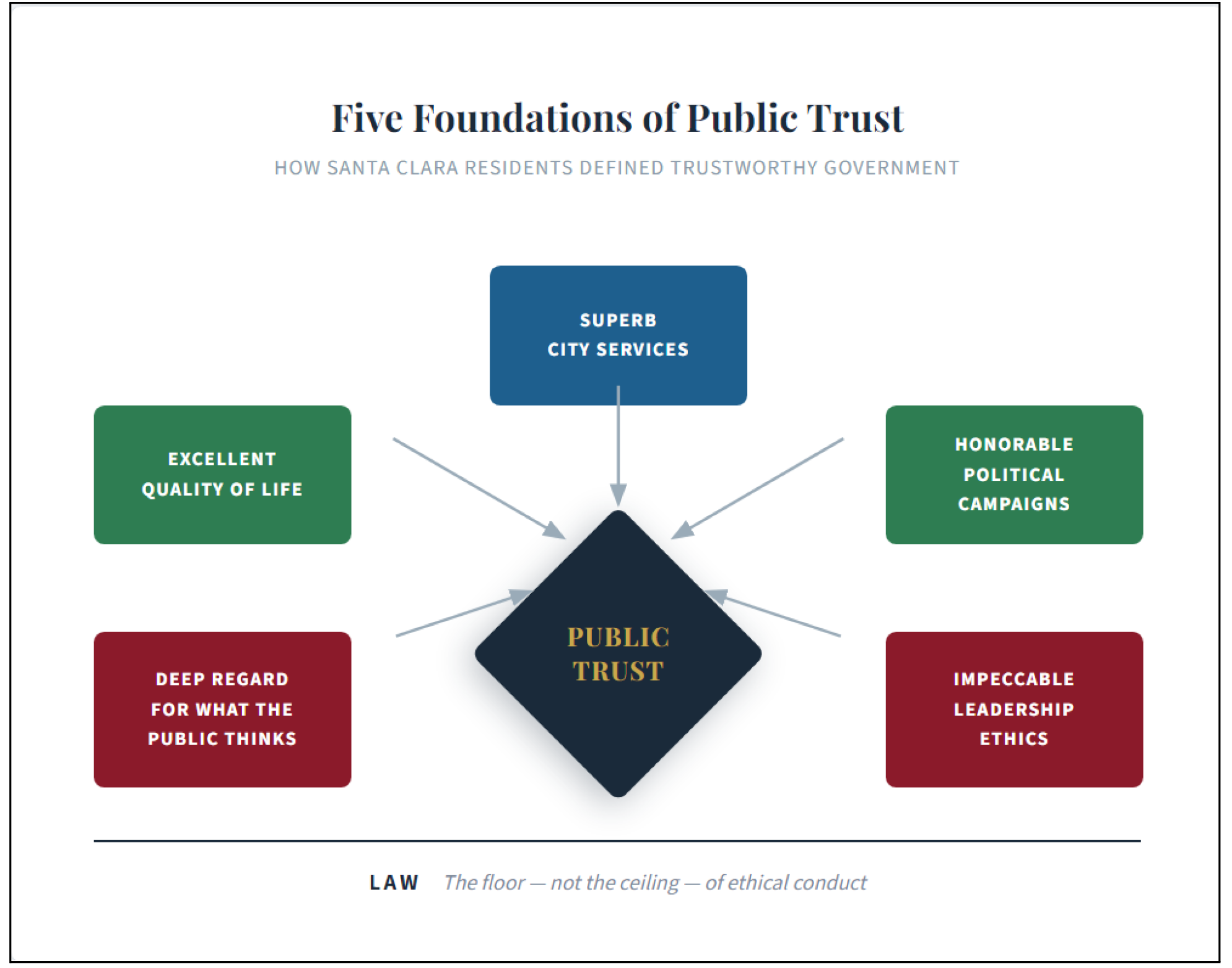
Public trust doesn't happen by accident. Santa Clara's survey research and its own experience show public trust grows--or weakens--based on five related judgments residents reach over time. When any one weakens, public trust weakens. When all five are strong, public trust grows.

The City defined public trust years ago as "the public's confident reliance that their government operates at all times, in public and in private, only in the best interests of the people."

Public trust in Santa Clara is strongest when residents and other stakeholders can answer "Yes!" to all five of these questions: 

  • Are city services as high quality and affordable as they should be?
  • Are political campaigns as honorable as they should be?
  • Is leadership ethics as impeccable as it should be?
  • Is quality of life as excellent as it should be?
  • Does the City Council show as much regard for what the public thinks as it should?

Santa Clara used to work hard to excel in all five areas. When people claim that public trust, ethical leadership, or good governance are abstract concepts, they need to rediscover the work the City did beginning in 1998 — turning abstract concepts into real-world behavioral standards—real-world words and actions that communicate to residents:  "We are worthy of your trust, and we are committed to acting in your best interests." 

Once-in-a-Generation Decision Points

Three initiatives are underway right now that will shape Santa Clara's government for decades. Done right, they could rebuild public trust and restore ethical leadership. Done poorly — or done in secret, without genuine public participation as two of them currently are— they will entrench the status quo and make reform harder than ever.

  1. Charter Review — The Charter Review Committee is doing genuinely good work, but two critical constraints threaten to undermine it: