
Overall, would you say Santa Clara is moving in the right direction or the wrong direction?
The City surveys said--
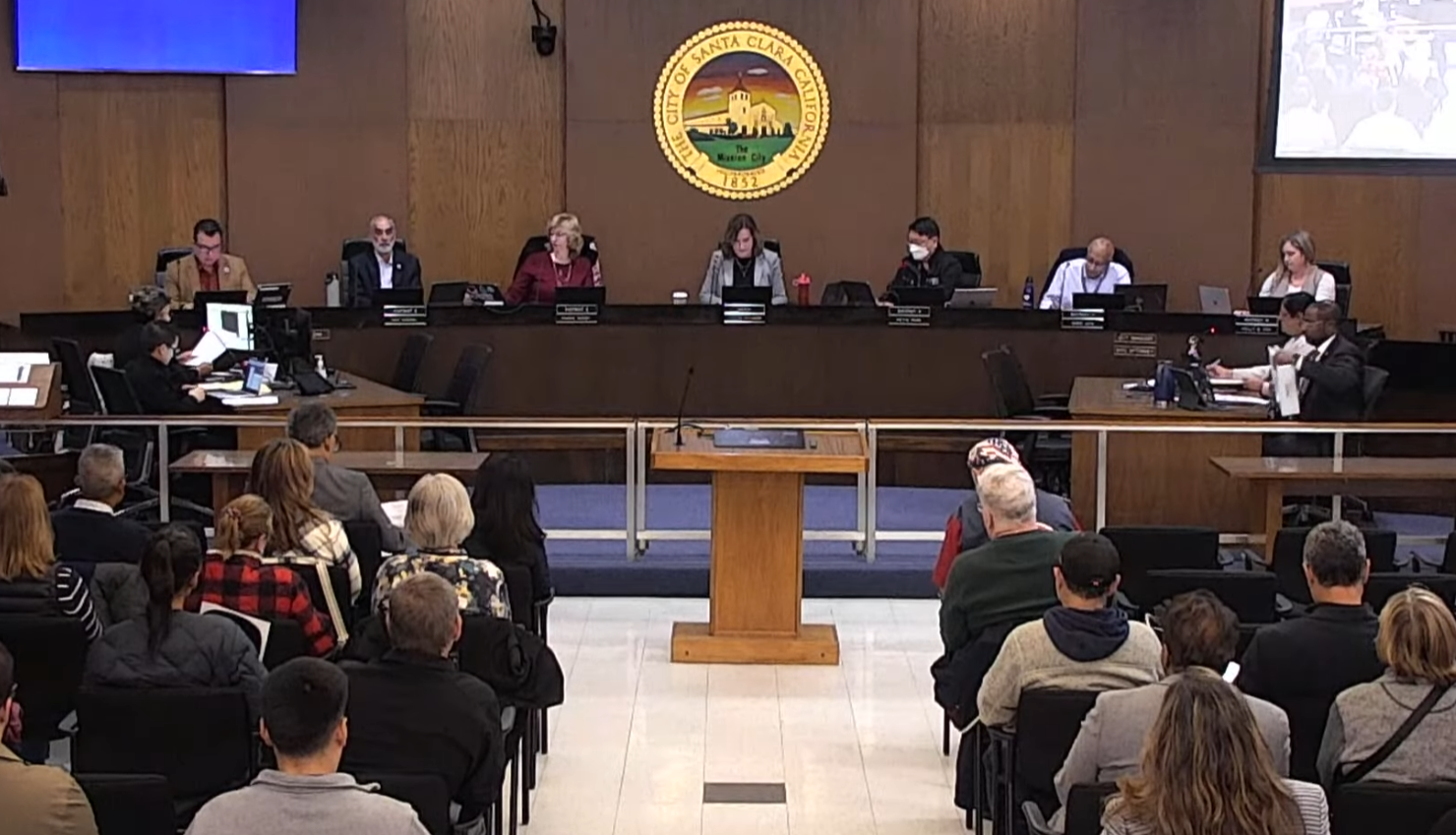
87%
2008
"Moving in the right direction"
40%
2024
"Moving in the right direction"
What Changed?
For years, the City encouraged its leaders to ask two questions before every decision:
1. Why is this the right thing to do for the people of Santa Clara?
2. How will my/our action build public trust?
Those two questions were printed on the pocket card at every council seat, every senior staff desk, and every commission chair — a daily reminder that ethics is both an individual and an organizational responsibility. One important lesson Santa Clara learned over 14 years: When leadership at the top commits the organization to behavior at our best, good people rise to it. [Read the full story]
When Santa Clara Got It Right
From 1998 to 2012, Santa Clara built one of the most comprehensive municipal ethics programs in California — from a values-based code developed from community consensus, through training for everyone, to structured reflection on how every decision affects public trust, to identifying stumbling blocks, learning from mistakes, and building the skills to do better.
Other cities copied it. Academic textbooks cited it. In 2006, six years after its approval, 91% of Santa Clarans said the City was moving in the right direction. [See the full record →]
A Sudden Reversal
Almost as soon as the 49ers announced Santa Clara as their stadium location in 2008, the City's attention shifted. Bedazzled by celebrity, financial possibility, and the sudden attention of deep-pocketed, politically connected people, city leaders:
- Too easily trusted what they were being told by proponents and supporters
- Without doing adequate due diligence, convinced one another that they were doing the right thing for the people
- Without listening to valid criticism from residents, minority council voices, and staff, decided that public trust would follow, despite the skepticism.
Early on, it was clear that the Council majority (Mayor Patricia Mahan, Jamie Matthews, Kevin Moore, Dominic Caserta, and Joe Kornder) was determined to make the stadium a reality.
The Decision That Changed Everything
By 2009, the ethics consultant had grown concerned that the stadium negotiations were raising serious ethics issues that the City Council was ignoring. As he wrote in a proposal he submitted to city staff in 2009—and again in 2010 and 2011: "Few City decisions have as much potential impact on the public's trust as the decision about the 49ers' new stadium." He proposed a formal initiative to identify and resolve ethics issues in the negotiations as they arose. The goal was to protect public trust.
The proposal was rejected without public discussion and without explanation. That was also true in 2010 and 2011.
In retrospect, it is clear that someone or some group made a conscious decision to exempt the stadium negotiations, the Stadium Authority, and the City's largest tenant from the ethics guardrails that applied to every other person and partner connected to Santa Clara's government.
A Government Without Ethics
That decision was a defining moment—and its impact is still being felt today.
The signal was unmistakable: ethics and public trust were no longer priorities at City Hall. Those who had built the program understood, and they left. In 2012, City Manager Jennifer Sparacino and Deputy City Manager Carol McCarthy retired. The ethics consultant departed after the 2014 election. The stakeholder Ethics Committee was dissolved. The Vote Ethics program disappeared. No one owned the ethics program, so no one came to its defense. Without champions, no city ethics program can survive, unless it has a permanent home in the city charter.
And in May 2014, Aldyth Parle—the original community architect of the program, its long-time Ethics Committee chair, and its most faithful guardian—died at 89. She had never stopped caring about ethics and public trust. Until the end, she kept saying, "Stay with it." With her death, the program lost its living memory and its conscience.
In 2019, the City moved to fire the 49ers' stadium management company. The 49ers sued immediately—and then went further. Beginning in 2020, the team's political action committees began systematically reshaping the City Council, spending $2.9M that first year and over $10 million on Santa Clara elections through 2024. The goal was clear: elect a Council majority that would protect 49er interests. It worked. With no ethics code governing how Stadium Authority Board members should interact with Team owners or lobbyists, behave, make decisions, or spend public money, residents repeatedly watched officials act less like independent public servants and more like 49er employees.
The same dynamic runs deeper still. The City Manager serves simultaneously as Stadium Authority Executive Director,the City Attorney as its General Counsel. There is no independent counsel, no independent executive, no one in either role whose exclusive job is to represent the public's interest.
Transparency and accountability were never built into the structure. What the public has learned has been largely accidental — and increasingly restricted. In agreements governing the stadium, the FIFA World Cup, and major litigation settlements, confidentiality provisions give the 49ers and their partners the practical power to decide what residents are allowed to know about how their public assets are being managed. When a council member moved in 2022 to discuss a major settlement in open session so the public could understand what their government was agreeing to, the motion failed. The explanation offered by Vice Mayor Becker: "We can't talk about this in public."
Time to Change Course
Santa Clara now faces another defining moment, and the decisions the City makes in the next few months will affect every Santa Clara stakeholder for generations.
Three of those decisions are already in motion — and each one is heading in the wrong direction:
-
Ethics Code — heading in the wrong direction\
The City's Ethics Code revision has three fatal flaws. First, the process: the City hired a law firm specializing in defending cities against employee lawsuits — not an ethics consultant — worked behind closed doors for a year, produced a replacement code with zero public input, and has refused to release the contract showing how "review" became "replace." Second, the product: the replacement is a compliance code requiring only legal minimums, stripping out the behavioral standards residents once used to hold officials accountable to community values. What's legal is not always ethical — the City knows this better than most. Third, the scope: the new code applies only to the City Council and not to commissioners, staff, or the Stadium Authority — the same Stadium Authority that has operated without any ethics code since 2014. [Read the full story →]
2. Ethics Commission — heading in the wrong direction
The Civil Grand Jury recommended an Independent Ethics Commission in both 2022 and 2016. The Council has rejected it three times. Now it is studying the idea again — but has already signaled the answer is no. Among the likely reasons for rejecting the Code:
a.) A Council subcommittee has the word "ethics" (Governance and Ethics) in its title and that is apparently sufficient oversight. That's what this Council claimed in its official response to the 2022 Unsportsmanlike Conduct report. That committee has discussed ethics exactly twice: when a consultant hired by City staff dropped a replacement ethics code in their laps without public warning, without clear materials in the packet, and without time for public input. An ethics commission designed, staffed, and evaluated by the people it is supposed to oversee is not an ethics commission. It is independent in name only and designed to fail. [Read the full story →]
b.) because the new ethics code is a follow-the-law compliance code, they will use the same logic they used with the city's gift ordinance: "We are required to follow so many State ethics laws, we don't need any more or our own Code. And since there are so many effective government oversight agencies (FPPC, DA, AGeneral) we don't need our own enforcement.
c.) we aren't a big city; it costs too much; it will have no power; it will be used as a political weapon against us; we will once again be criticized for policing ourselves or not policing ourselves.
3. Charter Review — heading in the wrong direction
The Charter Review is using a full public process — which is the right instinct and worth acknowledging. But it has two critical blind spots.
First, it excludes the Stadium Authority entirely, leaving unchanged the governance structure that three Civil Grand Jury reports have found puts the 49ers' interests above the public's.
Second, it makes no effort to embed an ethics infrastructure into the document itself — no protection against a future council dismantling what a future community builds, just as this Council dismantled what took fourteen years to create. A Charter that doesn't learn from Santa Clara's own history is a Charter that invites it to repeat. [Read the full story →]
To answer that, you need to look at the track record.
Today, our City Council, senior City staff, and/or the Stadium Authority:
1. Have no plan to protect Santa Clara's right to self-government from a known threat.
Self-government is a fundamental principle of democracy — voters, not deep-pocketed private interests, decide who runs, who gets elected, what information is released, and the culture of City Hall.
For the last three elections, 49er PACs and a compliant council majority have put Santa Clara's self-government at serious risk. If 49er PACs capture the Mayor's seat and two districts in 2026, Jed York and his associates will have effectively selected six of seven Council members — including the only City official elected by all Santa Clara voters.
Santa Clara plans carefully for unlikely emergencies like earthquakes and floods. This Council, City Attorney, and City Manager have never once publicly discussed what can be done to protect voters' right to self-government in November 2026.
This complex issue needs the best thinking of everyone with an idea to contribute. The City has created no space for that conversation — online or in person. Public Trust Now has. Stay tuned for announcements about how you can help shape Santa Clara's response to the 49ers' continued attempt to control its elections.
2. Have turned a program designed to level the playing field into a political game rigged in their favor.
Before 49er PACs began making unlimited independent expenditures, the City created a voluntary campaign expenditure program with a worthy goal: level the playing field. Candidates who signed the pledge agreed to spend no more than a set amount — approximately $25,000 for district races in 2024. Signing brought perks; signing and going over brought penalties. Most candidates sign.The catch: independent expenditures don't count toward the cap.
So in 2024, Mr. Park, Mr. Jain, and Mr. Gonzalez could each sign the pledge, watch 49er PACs spend hundreds of thousands of dollars on their behalf, and then tell voters they took no special interest money and honored their spending commitment.
It's like a college student telling his parents he stayed within his budget — without mentioning the fairy godmother who spent unlimited amounts on anything she thought he needed. [Read more →]
3. Failed to publicly repudiate attack ads from any source.
Every candidate signed the voluntary State Code of Fair Campaign Promises. No 49er PAC candidate in three elections fulfilled this promise to "publicly repudiate" attack ads, ads that lie about candidate or opponent, and other unethical campaign tactics.
So, while the 49er PAC candidates say they wish the 49ers would not spend money on their elections, talk is cheap. Most say, "What they are doing is legal. We can't do anything until the Supreme Court changes Citizens' United, which protects independent expenditures as corporate free and protected speech.
The specific promise is: "I SHALL IMMEDIATELY AND PUBLICLY REPUDIATE support deriving from any individual or group that resorts, on behalf of my candidacy or in opposition to that of my opponent, to the methods and tactics that I condemn. I shall accept responsibility to take firm action against any subordinate who violates any provision of this code or the laws governing elections."
4. Eliminated ethics advice and replaced ethics consults with nothing.
After 2016, the City eliminated on-call ethics consultation for city officials and city staff. From 1998 to 2016, the City retained an ethics consultant for ethics advice on difficult decisions, research into best practices, problem solving, communication breakdowns, help recognizing ethics issues, training, facilitation, and leadership coaching. For 8 election cycles, the ethics consultant was the public face of the Vote Ethics program and worked with the League of Women Voters to plan candidate forums and with candidates to help them use the City's ethics tools to think through ethics issues in their campaigns.
5. Fired the City Attorney and City Manager and did not hire permanent replacements for 17 months and 14 months
This left the Stadium Authority without a permanent Agency Attorney and an Executive Director to oversee the Management Company and negotiate with 49er officials. It was widely reported that the 49ers wanted these officials gone and the majority agreed, voting 5-2. During this time, the Council majority voted down an independent review of the settlement offer, which
6. Elevated a colleague to Vice Mayor after he was indicted for leaking a confidential report to benefit himself and the 49ers — then let him cast 49ers votes for 20 months
In October 2022, Councilmember Anthony Becker was challenging Mayor Lisa Gillmor—a longtime 49ers critic—in a race the 49ers had invested $2.5 million to help him win. On October 6, four days before its official release date, Becker leaked the confidential Civil Grand Jury report "Unsportsmanlike Conduct" via Signal to 49ers lobbyist Rahul Chandhok and to the Silicon Valley Voice, a publication with consistently 49ers-friendly coverage.
The 49ers' response was immediate. Within hours, Chandhok denounced the report as a "political hatchet job," accused the civil grand jury of "corruption," and directed a communications consultant to conduct opposition research on the individual grand jurors — volunteer citizens performing a public service. The DA later said the 49ers' smearing of grand jurors was "wrong and shameful" and called on the team to apologize. The team never did.
Becker's own texts revealed the strategy: "no mercy time" and "the Niners are going all out now to destroy her." When a campaign volunteer was later subpoenaed, Becker showed up at his door and told him to blame the leak on Gillmor.
Councilmember Suds Jain told the criminal grand jury that Becker had admitted leaking the report. At trial, Jain testified he must have been confused about the timing.
Becker was indicted in April 2023. His colleagues' response: they made him Vice Mayor. He waived his right to a speedy trial. For the next 20 months, he voted on every major 49ers issue before the Council — including the negotiated financial settlement with the 49ers and a vote against an independent ethics commission. The City Attorney remained silent through it all.
Even setting aside the indictment, the conflict of interest was obvious: the 49ers had spent $3.2 million on Becker's political career. No reasonable person could believe he had independence of judgment on any issue involving the team. His colleagues knew this. The City Attorney knew this. They let him vote anyway.
"Innocent until proven guilty" is the right standard for criminal punishment. It is not the standard for deciding who gets to vote on issues involving the people who funded their entire political career. Those are different questions, and conflating them—intentionally or not—is itself a failure of ethical judgment.
Becker ran for reelection in November 2024—this time without 49ers support, which went to another candidate instead. He came in last in a three-person race. His trial began the same week. He was convicted by a jury in under three hours on December 5, 2024, and resigned the following day. At sentencing, Councilmembers Suds Jain and Kevin Park asked the judge for leniency. He was sentenced to 40 days in the county work program and two years probation. He is currently appealing.
The 49ers spent over $3.2 million on Becker's campaigns. They never apologized.