
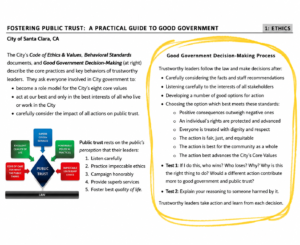
The Santa Clara pocket card was a training tool decision-makers used in the first few years after the Council approved the 2000 Ethics Code. It was designed to be folded in half, with one side focused on ethical decision-making and the other on the Code’s core values. The card was placed at each Council seat on the dais.
Recognizing Ethics Issues in Real Time — Part 1 of 3
In 1998, Santa Clara City Council Member Aldyth Parle walked into the Markkula Center for Applied Ethics at Santa Clara University, sat down with its executive director, and said:
“I’ve been on the City Council for two years. We talk about ethics issues all the time, but we never talk about them as ethics issues. We’ve had an ethics code since the 1960s, but it’s a list of do-nots and doesn’t help make hard decisions. Every six years, we take it out, dust it off, make a few changes, and then put it back in the file cabinet. There’s got to be a better way.”
Over the next dozen years, the City — working with Dr. Tom Shanks as its on-call ethicist — discovered a better way. It became the award-winning Santa Clara Program in Ethics & Values.
Aldyth, who had spent fifty years as Santa Clara County’s first public health nurse, had named the first and most important skill in ethical decision-making: recognizing that a decision involves ethics issues at all.
Twenty-eight years later, on the evening of July 14, 2026, the City Council made three very different decisions — committing $6.5 million to help operate a homeless shelter for families with children, considering an ethics advisor for the coming election, and updating the city’s charter — and reasoned its way through all of them without once naming the ethics they had in common, or the opportunity for ethical leadership they presented.
This short series, Recognizing Ethics Issues in Real Time, looks at how public officials can recognize when they are standing in the presence of an ethics issue, what to do about it, and why it matters. We start with the decision where, almost by accident, the city got it right: the Santa Clara Family Community.
The Step That Changes Everything
Recognizing an ethics issue is step one — and it is easier than it sounds, once you know the signs. A good rule of thumb for public officials and other Santa Clara stakeholders: Any decision that spends public money has ethics issues attached to it. So is any decision likely to help some people and burden others, to treat people differently, to advance or deny someone’s rights, to engage the government’s fiduciary duty to the public, or to set a private or special interest against the common good. The simplest test of all: if a decision will affect people’s lives for better or worse — and will either build the public’s trust or erode it — it involves ethics.
By that measure, almost everything of consequence a city council or City staff do qualifies. The skill is not spotting rare ethics issues; it is refusing to ignore the ones that are always there.
Step two is deceptively simple and quietly radical: before you begin even identifying options, identify the stakeholders and their real needs. In a city of roughly 130,000 people, that means asking at the very start — not the end — who is likely to gain and who to lose? Who gets a benefit and who gets a burden, in the short term and the long term? Have you made any promises to them, sworn any duties? What do their lives actually look like? Beneath their stated interests, what do they truly need from you, now and years from now?
Mike Markkula — the first investor in Apple, the man the Markkula Center is named for — built a whole company on that instinct. His one-page 1977 “Apple Marketing Philosophy” put empathy first: truly understand the person’s needs better than anyone else. He used to describe how, in the earliest days, the people building the first Macintosh kept a picture of an ordinary person — a mom, a teacher, a shopkeeper, someone’s grandmother — in view as they worked, so they never forgot whom the machine was for.
Government is harder than computer sales, because its product is good public service and its goal is earning the public’s trust. But the discipline is the same: know the actual humans on the other end of the decision. Stand in solidarity with them. Care about them. That is what turns a transaction into a transformation.
A Funding Vote with a Human Subject
On July 14 the Council voted, unanimously, to approve the funding agreement for the Santa Clara Family Community — a 30-unit interim supportive-housing development for families with minor children, at Benton and Lawrence, on county-owned land, built and co-sponsored by Santa Clara County and LifeMoves. The City’s part is to help pay for operations: roughly $6.5 million it first committed in 2023 and extended several times, with — as staff put it — “no funding obligation beyond year seven of this agreement.” The state awarded about $25.7 million in Homekey funds for the project itself, and local preference goes to Santa Clara families who live, work, or go to school in the city but have nowhere to live.
Handled as a transaction, that is all it is: an appropriation, some cost-overrun protections, a term of years. And for much of the evening, that is how it was handled.
What the Stakeholder Question Rebuilt
But this project carries a hidden history — a history of what happens when stakeholders figure out what they need, and then organize, show up, and speak up repeatedly.
When the project first came to the city, it was a four-story, low-barrier facility for 124 single adults. The surrounding community organized: three to four hundred residents turned out for the meetings. Their reaction was not simple. They were afraid for their children and wary of a low-barrier shelter for individuals next to their homes — made warier by reports that some of LifeMoves’ other sites were struggling — but, at the same time, many expressed real compassion for their homeless neighbors, and especially for their children. Most did not support the project as proposed. But nearly everyone wanted to do something for families with children.
That is the stakeholder question, asked by the public when the process didn’t ask it: who really benefits, who really bears the burden, and what do the people at the center of this — children, families, neighbors — actually need? Over two years, the answer rewrote the project. Council Member Kevin Park, who had opposed the original plan, named exactly what had happened:
“When this project came in front of us, it was aggregating children in a low-barrier facility that also allowed singles and individuals… this is the power of public input. When we look at what this project is today, it is very different from [what] was proposed in 2023… we reduced it from 124 units, single units, down to 30 family units. It’s not just prioritized for families, it was designed for families.”
The Transformation No One Named
There is the whole thesis of this series in one case. Nobody on the dais called the shelter an “ethics” decision. Yet the moment the stakeholders and their real needs were put at the center — the moment empathy became the design constraint — a transaction became a transformation. A building for 124 anonymous adults became a home designed to wrap around 36 families with children. The benefit to the public stopped being indirect and became the point.
And the trust that grows from that is its own reward. The city first committed this money in 2023 on a divided four-to-three vote, then kept the commitment through two years of delay, a redesign in the best interests of families and neighbors, a renegotiation of the agreement to make its terms mutually beneficial, and a long wait for state funding. A city that puts up years of operating money for a home it will not own, and keeps that promise to its most vulnerable through disagreements, earns trust — not because it set out to, but because it finally asked the two questions that turn ordinary business into ethical leadership: why is this the right thing to do for the people, and how will it build their trust? It passed unanimously. No one had to call it ethics for it to be exactly that.
Next: Part 2 — The Conversation Santa Clara Hasn’t Had in 20 Years, and Part 3 — The Comprehensive City Charter: Closed to Ethics, Postponed by Ethics. Figures and quotations are from the video record of the July 14, 2026 City Council meeting; Aldyth Parle’s words are recalled by Dr. Tom Shanks, to whom she spoke them in 1998, as is Mike Markkula’s account of the early Macintosh team. Public Trust Now welcomes corrections; if we’ve misstated anything, tell us and we’ll fix it and say so.
Join the Conversation
Public Trust Now examines City decisions through an ethics and public trust lens — and the conversation only works with your voice in it. Did we get something right, or miss something? What would you add? Share your perspective in the portal, and send this analysis to a neighbor who cares how Santa Clara is governed.
About Public Trust Now
Public Trust Now examines Santa Clara city government through an ethics and public trust lens, so residents can follow the reasoning, test it, disagree with it, and use the same tools themselves. Learn more about how we analyze a decision.
Public Trust Now operates independently of the Markkula Center for Applied Ethics and Santa Clara University. The Framework for Ethical Decision Making is used here for educational analysis; the conclusions we draw are our own, and should not be attributed to the Center, the University, or the City of Santa Clara.
Join the conversation
Reading is open to everyone — no account needed. To comment on this article or share your own perspective, become a Public Trust Partner and sign in to the portal.
Join Public Trust Partners →