
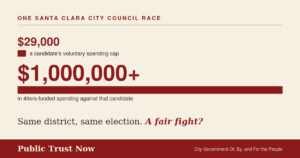
On paper, it’s one race. In practice, one candidate runs on about $29,000 while more than $1 million in 49ers-funded spending backs the other. Here’s what that gap buys — and what it could mean for November 2026. We’ve laid out the numbers. Is it a fair fight? The verdict is yours.
More than $10 million.
That’s what 49ers-funded independent-expenditure committees spent supporting and opposing candidates in Santa Clara’s City Council and mayoral races across three cycles — 2020, 2022, and 2024.
But it didn’t start with the council. Add it up:
- $4.3 million — 2010, to pass Measure J and build Levi’s Stadium.
- $630,000 — 2018, to defeat Measure C and keep Santa Clara’s six-district map instead of dropping to three.
- More than $10 million — 2020–2024, to shape who runs the city: the council and the mayor’s office.
Roughly $15 million. That’s what the 49ers have spent influencing Santa Clara elections since 2010 — to build the stadium, protect the map, and shape the officials who govern both.
The result? Five of seven seats — a supermajority on both the City Council and the Stadium Authority — were elected with extraordinary levels of “independent expenditure” funding. By law, PACs affiliated with the 49ers can spend unlimited amounts on local election campaigns, as long as they do not coordinate with the candidate or the campaign.
How much money are we talking about?
In 2022, most district candidates agreed to the City’s voluntary campaign spending cap — about $26,000 per candidate. At the same time, 49er-funded PACs spent more than a million dollars on each of two races:
- Raj Chahal — $1,082,471 ($687,939 supporting + $394,532 opposing)
- Karen Hardy — $1,125,072 ($684,103 supporting + $440,969 opposing)
One side spends about $26,000. The other spends over $1 million. Yet both can claim they followed the rules — because independent expenditures don’t count toward the cap. Only direct contributions to candidates do.
What does this mean in practice?
Consider 2026, when three seats will be open because Mayor Gillmor, Mr. Chahal, and Ms. Hardy all “term out” (unless Mr. Chahal or Ms. Hardy decide to run for mayor). What does a candidate-controlled campaign — capped at roughly $29,000 by the Council on April 7, 2026 — look like next to a $1,000,000-plus independent campaign run on your opponent’s behalf? And what might that look like this coming November?
We gave both budgets to Claude and ChatGPT and asked them to show what each might buy in 2026 — then checked the costs and the likely impact on the race for accuracy and clarity. As you read it, ask yourself: is this a fair fight? And what can anyone do about it?
Here is what that gap looks like from a voter’s mailbox. The capped candidate can afford about two mailers and a walk piece — roughly three pieces reaching a household across the entire campaign — a small digital buy in the final weeks, and a campaign run by the candidate and a few friends. No pollster. No general consultant. Decisions made on instinct and on what people say at the door.
The candidate backed by outside spending is running a different election. More than $170,000 goes to direct mail alone — five mailers promoting that candidate and six attacking the opponent, premium stock, close to eleven pieces per household. Hundreds of thousands more go to YouTube, social, and programmatic ads, to a $90,000 general consultant, and to $84,000 in polling that tests every message before it airs — including push polls dressed up as research. By the time most voters start paying attention, one name is already everywhere and the other is a stranger.
Same district. Same ballot. But the two candidates are not running in the same election. One has been shaping what voters see for months; the other, most voters never knowingly encounter. The race is half-decided before a single vote is cast — not by who is the better candidate, but by who could afford to be seen.
Click this red button to see the chart comparing what $29,000 buys in a Northern California election campaign with what $1M buys you.
All of this is legal. In 2010, the Supreme Court’s Citizens United decision treated companies as persons with a First Amendment right to spend without limit on independent expenditures. That is the law.
But law is the minimum standard — the floor, not the ceiling. Breaking the law always damages public trust. But following the law does not earn it. Following the law is an expectation, not an achievement. Ethical leadership requires more: decisions and conduct that earn and maintain public trust.
Public trust rests on two basic pillars:
1. Loyalty to the public. Officials must act in the community’s best interests above all others — and explain how they reasoned their way to a decision, especially why it is the right thing to do for the people and why they believe it will build public trust. Not the thin reasons given for supporting or opposing a motion today, but a full account of the thinking.
2. Fairness. Government must treat people equitably and ensure a level playing field. Much of public ethics comes down to how decision-makers handle conflicts of interest — situations in which their obligation to the public and an obligation to someone else, such as a major donor, may collide.
The 49er PACs’ actions over three elections have led many residents to ask whether an official can remain fully independent when their election depended on that level of outside support. The question is compounded by the meetings the new majority held with 49er lobbyists in 2021 and 2022 — 50 for Mr. Chahal, 77 for Mr. Park, in groups of two or three. The Council said the meetings were needed to understand the contracts and the relationship.
That may be true. But over two years, the team’s representatives were also lobbying the new majority — explaining the stadium and contracts from the 49ers’ perspective, airing the team’s problems with the City Manager and City Attorney, and building the personal relationships that come with that many meetings.
The City Council Voting Bloc can — and do — vote in a manner favorable to the Team. By aligning itself with ManCo, the City Council Voting Bloc has effectively breached its duties to the City.
Santa Clara County Civil Grand Jury, 2022, p. 20
This behavior has continued. Week after week, residents see the Stadium Authority make decisions that appear aligned with the 49ers’ interests. Instead of disclosing and resolving the conflict, there has been silence — from the Council, the Manager, and the City Attorney.
Robert Wechsler, one of the most respected municipal ethicists, describes exactly the problem Santa Clara faces:
From the point of view of citizens, when an official has a conflict, does not disclose it, and does not withdraw from participating in the matter, he may purport to be acting as an official — but if it comes out, he will be seen as a concealed agent of whoever it is he has a special relationship with. He will be seen as selfish and untrustworthy. And, more important, the government that does not insist on him dealing responsibly with his conflict will be seen as a bunch of people who are in it for themselves and their family and friends.
Robert Wechsler, Local Government Ethics Programs (City Ethics, Inc., 2013), p. 29
So what does $15 million actually buy?
Not just mailers and ads. It buys two different elections inside the same race — two separate information environments. One candidate’s story reaches voters at the scale of $29,000. The other’s is told, again and again, at the scale of a million dollars or more.
And here is the part that should trouble anyone who believes in self-governance: because these are independent expenditures, the candidate is not supposed to control them. The 49ers decide what to emphasize, which messages to send, and how to attack the opponent. A candidate who runs inside that environment — and does nothing to disown it — has ceded a piece of their own campaign, and a piece of Santa Clara’s self-government, to the team.
“What can we do?” one of them asked Dr. Shanks. It sounded like helplessness. It was not a request for help — it was a way to end the conversation before it started, to close off any serious search for ways to push back.
But there was something they could do, and every one of them had already promised to do it. When they signed the State’s Code of Fair Campaign Practices, they pledged to immediately and publicly repudiate unfair or negative attacks made on their behalf. Across three election cycles, not one 49er-backed candidate has done so — not once — even while privately wishing the spending would stop.
Why not? Because the Code asks for a promise and never checks whether it is kept. It carries no oversight, no accountability, no sanction. You can sign it on Monday, benefit from a million-dollar attack on Wednesday, and forget you ever signed it — with no consequence at all.
Santa Clara has seen this exact failure before — in its own ethics code. After the 2016 election, the Council let Vote Ethics lapse — the city’s nonpartisan public ethics education program, and with it the accountability system built into the ethics code itself. As Mayor Patricia Mahan described its purpose, “It was not our effort to change the outcome of elections, but to change the behavior of candidates.” From 2016 to today, the city’s ethics code has had no independent oversight and no accountability behind it. The lesson is the same in both places: a promise without oversight is a promise that predictably goes unkept. Oversight is not a nicety of a public ethics program; it is the thing that makes the program real. Without it, there is no one to hold a self-policing majority accountable, and no one to hold a person — or a city — to the promises they freely made.
That is precisely the gap an independent ethics commission is built to close: a body with the standing to ask the questions no one is currently required to ask. No questions, no answers, no trust.
We’ve laid out the numbers. Is it a fair fight? The verdict is yours.
Join the conversation
Reading is open to everyone — no account needed. To comment on this article or share your own perspective, become a Public Trust Partner and sign in to the portal.
Join Public Trust Partners →