
Is Santa Clara Moving
in the Right Direction?

Santa Clara once led California in municipal ethics. Its nationally recognized ethics program was studied, copied, and trusted by residents. 

In 2008, at the height of the program, 87% of Santa Clara residents said the City was going in the right direction.

Today, the ethics program has largely disappeared. In 2024, just 40% said the City's direction was the right one.

Santa Clara now faces once-in-a-generation decisions that will either rebuild public trust through ethical leadership—or deepen a City Hall culture that ignores ethics, rejects criticism, excludes the public, and treats public trust an afterthought.

Santa Clara Faced These Choices Before

Twenty-six years ago, the people of Santa Clara told the City Council they had had enough.

Enough of the negative political culture growing in the City with its win-at-all-costs election campaigns.

Residents were looking for something better: ethical leadership, fair elections, an ethics code that provided practical help, and a city government worthy of public confidence.

To its credit, City officials and Senior staff listened, acted, and engaged the public in new ways. 

The City and the People Partnered

City government and residents began working together as partners to define what trustworthy government looked like in practice. That partnership is a main factor in the success of the program. 

The Mercury News called it Soul Searching in Santa Clara.

Santa Clara asked its people a question most cities are afraid to ask:

When government is at its best earning the public's trust, how does it act?

How do trustworthy public officials treat residents, each other, and City staff? How do they make decisions when what's best for the people conflicts with what they think is best for their donors, their business, their political agenda, their family and friends? What do they promise residents — and how do they hold themselves accountable for keeping those promises?

Beyond Legal Compliance

To answer those questions, the City first looked to its 1960's era "follow the law" compliance ethics code. Surely that would describe trustworthy government?

It didn't. Santa Clara's Code, like most codes at the time, just said: "Follow the law."  These were described primarily as a set of "Do Nots."  (As in "Do not lie, cheat, or steal.")

Cities understood that breaking the law destroys public trust. Over time, they learned that earning trust requires more than simply following the law. Law is the minimum standard of public service, not the definition of ethical leadership. Law is what we must do.  Ethics is what we ought to do to earn the most trust.

Ethical leadership is decision-making that is done in the best interests of the public, meeting their needs with honesty, impartiality, accountability, and fairness.  In fact, these are the fiduciary duties all elected and appointed leaders promise the people they will fulfill.  

Santa Clara rejected its old compliance-based code because it provided no vision or standards for trustworthy government.

The Code of Ethics & Values

Working with Dr. Tom Shanks, then Executive Director of SCU's Markkula Center for Applied Ethics, the City then developed the first consensus-driven, integrity-based Code of Ethics and Values in California.

Instead of legal rules and "do not's," this Code focused on positive ethics, which the City defined as "the way city government and officials act when they are at their best earning public trust."

Every official pledged to practice the eight consensus core values developed earlier.  As a representative of Santa Clara, I will be ethical, professional, service-oriented, fiscally responsible, organized, communicative, collaborative, and progressive.

Those values were translated into real-world behaviors that showed city officials and residents alike what trustworthy government looks like in practice.  The City then turned those into ethical standards, which prescribed how trustworthy City officials ought to act in order to earn the people's trust. 

The City adopted the Code in 2000 and immediately began a continuous "Make It Real" implementation program. In 2008, the City added Behavioral Standards for Council members for easch of the Code's standards.  Column 3 of 4 listed what each Code standard looked like in practice, in words and deeds people could hear and see.  Column 4 listed the words and behaviors to avoid, what the Code's standards did not look like in practice.

For more than a decade, Santa Clara was a role model for cities across California.

The City also knew that no ethics code works effectively unless it is bundled with effective accountability and, when necessary, enforcement. The City opted to put that accountability into the hands of voters. 

Every two years for eight election cycles, in a voluntary program, the City taught candidates the nuts and bolts of running an honorable campaign.  At the same time, the Ethics & Values program ran an expansive nonpartisan education program so residents could recognize ethical campaigns and hold candidates accountable. As Mayor Pat Mahan put it: "Our goal was not to influence the outcome of elections. It was to influence the behavior of candidates."


It Worked...Then It Didn't

For more than a decade, it worked. Residents trusted their government — and the numbers showed it. In 2008, 87% said Santa Clara was going in the right direction.

That same year, the San Francisco 49ers announced they planned to build their new stadium in the City of Santa Clara.  They bedazzled the City Council with celebrity and financial possibilities for the City.

Quietly, the Ethics Program began to unravel.  The Council majority (Mayor Pat Mahan, Jamie Matthews, Dominic Caserta, Kevin Moore, and Joe Kornder) were determined to make the stadium a reality. Other City programs got very little attention. 

But that's too easy an explanation for what happened next.  By 2009, the ethics consultant, Dr. Shanks, was alarmed because the 49er discussions were raising pubic ethics issues which the Council ignored.

In 2009, 2010, and 2011, Dr. Shanks proposed a special program to senior City staff that would focus on identifying and resolving ethics issues as they emerged in the 49ers negotiations. He wrote, "Few city decisions have as much potential impact on public trust as the decisions about the 49ers new stadium."

He proposed that he train City staff to prepare an Ethics Impact Report to accompany staff recommendations.  This report would draw the Council's attention to ethics and values issues at stake in each decision. This was not to block the stadium, but to protect public trust.

The proposal was rejected, without public discussion, each year for the three years Dr. Shanks proposed it. 

In retrospect it is clear that someone or some group involved in the negotiations decided to exclude ethics and later the Ethics Code from the Stadium Authority discussions, the Stadium Authority itself, and the City's tenant in the largest City asset. The Council, staff, city contractors and vendors were all held to the City's Code of Ethics & Values, except for the Stadium Authority, the 49ers, Manco, and Stadco.  

So when the Silicon Valley Voice asked in 2022 and Anthony Becker asked in 2023 "Where was ethics in the Measure J campaign?" the answer is "It would have been there, but someone decided that there was no need for ethics in the approval process for Levi's Stadium. 

The ethics consultation budget disappeared. The Vote Ethics accountability program — eight election cycles of nonpartisan candidate education — ended after 2016 without explanation. The "Make It Real" implementation program that kept the Code alive in daily practice quietly stopped. One by one, the pillars of the program were removed, not in a single dramatic decision but in a series of small decisions across multiple Councils.  They were easy to miss unless you were watching closely.

Dr. Shanks started watching closely in early 2022 after the City Attorney and then the City Manager  were fired.  He made copies of the Behavioral Standards pages and used them to evaluate what he was seeing. The last two columns of the standards lists the behaviors that correspond to the Code's standards, and behaviors to avoid. Meeting after meeting, Council consistently engaged in behaviors in the "Avoid" column.  He said so in an op-ed in the San Jose Mercury News that fall.

By the time most residents noticed, there was nothing left to save — only something to rebuild.
What Kind of City Will We Be?

From 1998 to 2012, the City of Santa Clara asked residents the same question in many different situations: When your city government is at its best, earning your trust, how do its leaders act?

These are the answers Santa Clara residents gave:  At their best, Santa Clara's officials: 

  • Tell the truth
  • Do the right thing
  • Value ethical leadership
  • Work at all times only for the people's best interests
  • Engage and listen to the people
  • Conduct fair election campaigns
  • Are careful stewards of the people's money
  • Provide high quality, affordable city services
  • Manage public assets—including Levi's Stadium—for the people's benefit
  • Are accountable—and show evidence of promises kept.

Those answers became Santa Clara's consensus core values and the heart of the Santa Clara Code of Ethics & ValuesAs a representative of Santa Clara, I will be ethical, professional, service-oriented, fiscally responsible, communicative, collaborative, and progressive. The Code defined each of those values in practical terms. The City then turned those values into clear behavioral standards: specific words and actions that showed everyone what the values looked like in practice, and behaviors to avoid.

That work earned Santa Clara national and international recognition. It led to 87% of city residents saying the City was going in the right direction.

Today the training and other programs and people who supported the Code are gone. Now the Code itself is under threat. A recent public records request showed that the City has been working behind closed doors since March 2024 to get rid of the award-winning Code of Ethics & Values.

The lawyer the City hired to review the ethics documents came to her March 2025 meeting with the Governance & Ethics Committee (GEC), a Council subcommittee that usually meets at 10 a.m. on Monday mornings, not with a review, but with a draft replacement Code for the City Council. It does not apply to the other elected officials, City Commissioners, or City Staff. 

The current Code sees the law as what we must do and ethics as what we need and ought to do to build public trust. The replacement Code is a rules-based "follow the law" compliance Code, like the City's old code, rejected 25 years ago because it didn't help anyone make difficult decisions that built public trust.

Some of the good government behaviors at the top of this section are mandated by law, but most are not. This is why the City defined ethics as the way city officials and the city organization act when they are at their best earning the public's trust. Good government behaviors aren't ideals invented by reformers or dreamers. They're how residents said they expect city leaders to act when they are trustworthy. Some city officials have dismissed this list as fit only for dreamers, saints, and fools — not pragmatic politicians who live in the real world.

The people of Santa Clara disagree. The City created good government once—and it lasted for a dozen years. Residents have the right to demand it again.

What Changed--and Why It Matters Now?

In 2008, Santa Clara's nationally recognized Code of Ethics & Values had been in place for eight years—and it showed. Eighty-seven percent of residents said the city was headed in the right direction.

Then the 49ers arrived. In 2010, the team spent $4.3 million to pass Measure J — winning with 58% of the vote.  What the Mercury News called "an overwhelming margin" is a questionable conclusion since stadium approval from the 14,628 people who voted for it is roughly 12% of the city's population.

What team owners learned through that campaign, though, they applied directly to City elections after the City tried in 2019 to fire the 49er affiliate Manco, whom the City pays to manage the stadium all year and book non-NFL concerts and events after football season.

Through 2024, the 49ers spent approximately $15.5 million on Santa Clara elections, creating a Council and Stadium Authority supermajority that consistently votes, the Civil Grand Jury found in 2022, "in a manner favorable to the team."

During this period the ethics program was quietly dismantled.

Three Civil Grand Jury reports documented the damage. The majority dismissed the first outright; they have delayed, deflected, or hired consultants who have delayed action on the rest.

One 2010 Measure J promise, to create a useful community space, has been delayed until 2027 after the Super Bowl and FIFA, again putting the team's agenda ahead of the public's. 

Much of the dismantling happened out of public view—a replacement ethics code developed in secret; a stadium settlement signed the morning after a closed Council meeting that had "no reportable action"; and more than 57 private meetings between 49ers-aligned council members and the team's lobbyists, usually logged on public calendars as "SCSA/49ers."

From the 49ers' perspective, those 57 meetings were a highly effective onboarding for the new majority, resulting in firing the City Attorney and City Manager, changing the Stadium curfew rules, and signing a team-proposed legal settlement without independent confirmation of the benefits. 

By 2024, only 40% of residents said the city was headed in the right direction — a collapse of nearly 50 points in a measure closely linked to public trust. Santa Clara last formally surveyed residents on public trust in 2008. It hasn't since. It should.

This is what happens to a city when ethics is ignored, treated as a political weapon, and has no effective, timely, and independent ethics oversight. 

What Builds Trust in Santa Clara

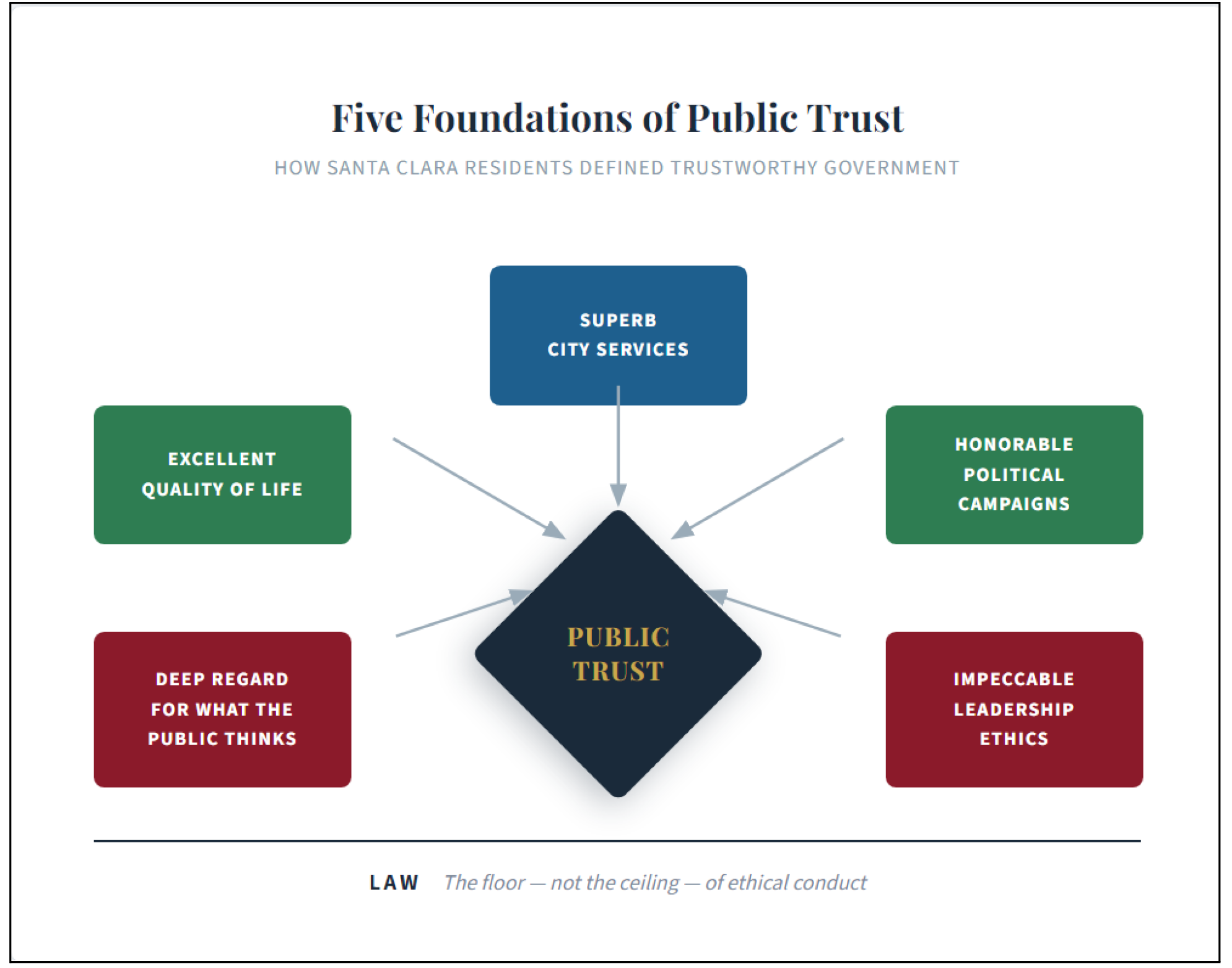
Public trust doesn't happen by accident. Santa Clara's survey research and its own experience show public trust grows--or weakens--based on five related judgments residents reach over time. When any one weakens, public trust weakens. When all five are strong, public trust grows.

The City defined public trust years ago as "the public's confident reliance that their government operates at all times, in public and in private, only in the best interests of the people."

Public trust in Santa Clara is strongest when residents and other stakeholders can answer "Yes!" to all five of these questions: 

  • Are city services as high quality and affordable as they should be?
  • Are political campaigns as honorable as they should be?
  • Is leadership ethics as impeccable as it should be?
  • Is quality of life as excellent as it should be?
  • Does the City Council show as much regard for what the public thinks as it should?

Santa Clara used to work hard to excel in all five areas. When people claim that public trust, ethical leadership, or good governance are abstract concepts, they need to rediscover the work the City did beginning in 1998 — turning abstract concepts into real-world behavioral standards—real-world words and actions that communicate to residents:  "We are worthy of your trust, and we are committed to acting in your best interests." 

Once-in-a-Generation Decisions

Three initiatives now underway will shape Santa Clara’s government for decades.

Handled well, they could rebuild ethical leadership and restore public trust. Handled poorly — or handled without meaningful public participation — they could entrench the status quo and make reform far more difficult.

Santa Clara once led California in municipal ethics. The decisions
made now will determine whether it leads again — or continues to fall behind.

Charter Review

The City Charter is being updated.

But the Stadium Authority—which shares leadership, staff, and legal counsel with the City—has been excluded from the review.

Without addressing the Stadium Authority, the Charter cannot fully resolve Santa Clara’s most significant governance and ethics issues.

Without including the Stadium Authority, how can the Charter accurately describe the roles of the Council, City Manager, City Attorney, and City Finance Director?

The Charter functions as Santa Clara’s constitution. Excluding the Stadium Authority would be like writing the U.S. Constitution but leaving out the presidency—ignoring one of the most powerful institutions shaping public decisions in the city.

Ethical leadership, good governance, fiduciary duties,  and public trust should be a unifying theme for the proposed charter.  Public Trust  and ethics infrastructure protections should also be embedded in the Charter so future Councils or staff cannot ignore or dismantle them—only strengthen them.

Key Questions

• How should the Charter address Stadium Authority governance?
• How should conflicts between City and Stadium roles be handled?
• Which ethics protections should be embedded in the Charter?
• Why are these decisions the right thing to do for the people? 
• How, if at all, will these decisions build public trust?  

Ethics Code Red

Santa Clara’s nationally recognized Code of Ethics & Values may soon disappear, and be replaced by a weak "folliow the law" compliance code. 

The City has developed the proposed replacement largely behind closed doors over the past two years, working with a lawyer whose firm has been defending the City against employee lawsuits for 40 years. So much for hiring an independent ethics consultant using the City's regular RFP (or RFQ) process.

By scheduling two public meetings before an obscure Council subcommittee that meets quarterly on Monday mornings, City staff have shown precious little regard for public trust. 

Early drafts show a major shift from a values-based ethics code that aims for at-our-best behavior to a minimal compliance document focused mainly on following existing laws.

Santa Clara adopted a values-based code in 2001 because the old compliance code provided little help when officials faced difficult decisions involving public trust. A strong ethics code should guide judgment, not simply repeat minimum legal requirements.

Key Questions

• Why replace the current Code instead of expanding it?
• Why was the process conducted without public participation?
•Why were ethics consultants not invited to apply?
•Why are values-based Codes recommended?
• Why are these decisions the right thing to do for the people? 
• How, if at all, will these decisions build public trust? 

Ethics Commission

Two Civil Grand Jury reports recommended an independent ethics commission to provide oversight this Council cannot provide for itself. The Council has now agreed to study creating one—but has also directed its consultant to include “alternatives” to a commission.

The consultant designing the commission is the same employment defense attorney who drafted the proposed replacement ethics code. Defense attorneys are trained to protect organizations from liability, which naturally emphasizes limiting jurisdiction and minimizing exposure.

Designing an ethics commission to succeed requires the opposite approach: genuine independence from the officials it oversees, impartial appointments no council can control, adequate resources to investigate when needed, and a strong focus on prevention, advice, training, and ethical culture—not just enforcement.

Before a design emerges, the public deserves to understand what kind of oversight Santa Clara is actually being offered.

Key Questions

• Why spend $78,000 on an idea Council has rejected twice? 
• Why hire an employment defense attorney with no ethics commission experience?
• Why has the public been kept from meaningful participation?
•Why are these decisions the right thing to do for the people? 
• How, if at all, will these decisions build public trust?  

The Bulldozer Is Already In the Yard

Twenty-five years ago, a long-time Santa Clara resident on the ethics ordinance committee pulled Dr. Shanks aside after one of the committee meetings. He didn't want Dr. Shanks to be disappointed if other residents didn't respond to the request to participate in the ethics development process.

"You've got to understand," he said. "Santa Clara residents won't respond to City Hall unless there's a bulldozer with the City's name on it in their front yard. It's already knocked down the fence and it's on its way to the front door. Then they'll respond."

After working on this site for the past three months, we believe that bulldozer has arrived. It has already knocked down the front fence, and it's on its way to the front door. There is no time to lose.

The people are the only force with the political power to change a city's direction. Thomas Jefferson understood what this moment requires:

Whenever the people are well informed they can be trusted with their own government; that whenever things get so far wrong as to attract their notice, they may be relied on to set them to rights.

Article II Section 1 of California's Constitution makes it law:

All political power is inherent in the people. Government is instituted for their protection, security, and benefit, and they have the right to alter or reform it when the public good may require.

The public good needs your attention. Public Trust Now is here to help.

What You Can Do

Santa Clara was once a role model for ethical leadership and public trust. Residents can help the City become that again. Here's how to start.